English
 Español
 tiếng việt
 русский
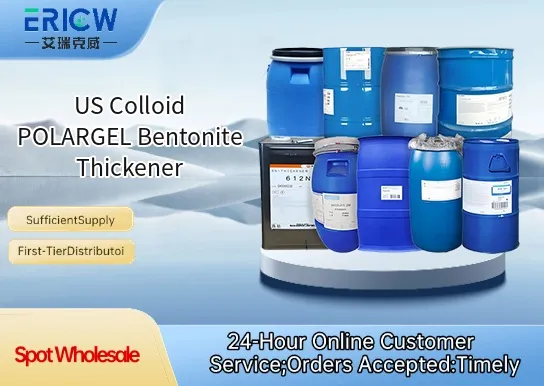
High-yield natural sodium bentonite with exceptional rheological control in aqueous systems.
Fast hydration and dispersion without requiring mechanical shear or prolonged aging.
Excellent suspension stability for solids in low-to-medium pH formulations.
Non-ionic, compatible with anionic, cationic, and non-ionic surfactants and polymers.
Consistent performance across batch lots, meeting stringent US Colloid quality assurance standards.
Water-based paints and architectural coatings for sag resistance and anti-settling.
Industrial cleaning gels and aqueous degreasers requiring thixotropic structure.
Drilling fluid additives in non-damaging, low-solids mud systems.
Agrochemical suspensions (SC, SE formulations) to stabilize active ingredients.
Personal care gels and rinse-off products where clarity and mildness are critical.
| Chemical Type | Sodium bentonite clay |
| Product Form | Fine free-flowing powder |
| Appearance | Off-white to light tan powder |
| Primary Applications | Rheology modifier, suspending agent, thickener |
| Key Features | Shear-thinning, thixotropic, high yield value |
| Benefits | Reduces settling, improves application properties, enhances storage stability |
| pH Range (1% slurry) | 8.0–9.5 |
| Moisture Content (max) | 10.0 wt% |
Q1: What is the primary function of POLARGEL in formulations?
A: POLARGEL is a sodium bentonite-based rheological modifier designed to provide suspension stability, yield stress development, and thixotropic behavior in aqueous systems—particularly where controlled flow and anti-settling performance are critical.
Q2: How does POLARGEL differ from conventional bentonite thickeners?
A: POLARGEL is pre-activated and surface-modified to deliver rapid, consistent dispersion and enhanced swelling efficiency in water without requiring extended aging or high-shear pre-hydration—reducing processing time and improving batch-to-batch reproducibility.
Q3: Is POLARGEL compatible with electrolytes and moderately acidic or alkaline systems?
A: POLARGEL demonstrates improved tolerance to moderate ionic strength and maintains functional viscosity across a pH range of approximately 5–10, though performance may diminish under highly saline or strongly acidic conditions (pH < 4) due to clay platelet aggregation.
Q4: What types of industrial applications is POLARGEL commonly used in?
A: It is widely employed in water-based coatings, architectural paints, agricultural adjuvants, drilling fluids, and specialty cleaning gels—where reliable suspension of pigments, solids, or active ingredients is required alongside non-drip or sag-resistant application properties.
Q5: How should POLARGEL be incorporated into a formulation for optimal performance?
A: For best results, disperse POLARGEL gradually into the aqueous phase under moderate agitation—preferably using a high-shear mixer—to ensure full wetting and prevent agglomeration. Dosage typically ranges from 0.1% to 2% by weight, depending on desired viscosity and formulation complexity.
Contact With Us:
E-mail: wangxingqiang@ericwchem.com
Have a Questions? Call Us:
Add:
Building A1, Jiete Industrial Park, Huangpu District, Guangzhou City, Guangdong Province, China