English
 Español
 tiếng việt
 русский
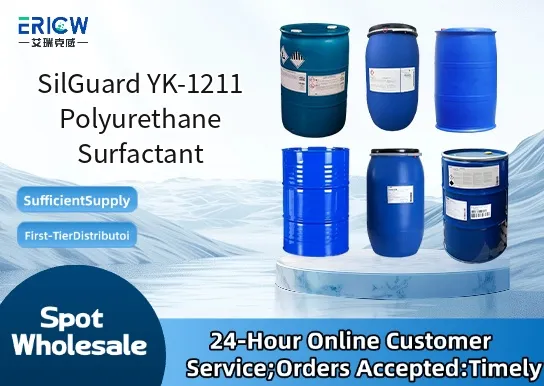
Optimized silicone-polyether copolymer structure for superior foam stabilization in flexible polyurethane systems.
Low surface tension and excellent migration resistance, minimizing surface defects and craters.
High hydrolytic stability ensures consistent performance during storage and processing.
Compatible with conventional amine and tin catalysts, as well as common polyol and isocyanate blends.
Non-VOC compliant formulation supporting low-emission foam production requirements.
Flexible slabstock polyurethane foam for bedding and furniture.
High-resilience (HR) molded foam used in automotive seating.
Integral skin foams for steering wheels, armrests, and dash components.
Water-blown and low-pressure foam systems requiring fine cell structure control.
Fire-retardant foam formulations where surfactant compatibility with FR additives is critical.
| Chemical Type | Silicone-polyether copolymer |
| Product Form | Liquid |
| Appearance | Pale yellow to colorless clear liquid |
| Primary Applications | Foam stabilization in flexible polyurethane systems |
| Key Features | Foam nucleation, cell opening, and surface defect suppression |
| Benefits | Improved foam uniformity, reduced density variation, enhanced processing robustness |
| Density (25°C) | Approx. 1.02–1.05 g/cm³ |
| Flash Point (PMCC) | >120°C |
Contact With Us:
E-mail: wangxingqiang@ericwchem.com
Have a Questions? Call Us:
Add:
Building A1, Jiete Industrial Park, Huangpu District, Guangzhou City, Guangdong Province, China