English
 Español
 tiếng việt
 русский
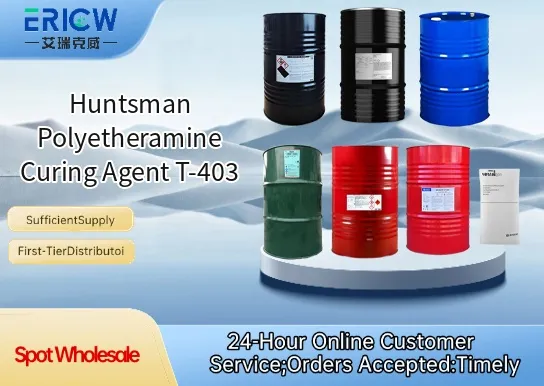
Low-viscosity liquid enabling easy handling and efficient mixing with epoxy resins.
Flexible aliphatic polyetheramine structure delivering excellent toughness and impact resistance in cured systems.
Low color and low odor, supporting high-clarity and aesthetically demanding applications.
Good hydrolytic stability and moisture tolerance during processing and storage.
Enables room-temperature or elevated-temperature curing with balanced reactivity and pot life.
Epoxy-based adhesives for aerospace and automotive structural bonding.
Composite matrix resins for wind turbine blades and lightweight transportation components.
Coatings requiring flexibility, chemical resistance, and low-temperature cure performance.
Electrical encapsulants and potting compounds for electronics protection.
Grouts and repair mortars where reduced brittleness and thermal shock resistance are critical.
| Chemical Type | Aliphatic polyetheramine (tri-functional) |
| Product Form | Liquid |
| Appearance | Colorless to pale yellow, clear liquid |
| Amine Value | 215–235 mg KOH/g |
| Viscosity at 25°C | 150–250 cP |
| Specific Gravity (25°C) | 0.97–1.01 |
| Reactive Hydrogen Equivalent Weight | ~100 g/eq |
| Primary Applications | Epoxy resin curing agent for adhesives, composites, coatings, and encapsulants |
Q1: What is the primary function of T-403 in epoxy systems?
A: T-403 is a polyetheramine-based curing agent designed to react with epoxy resins, enabling crosslinking at ambient or elevated temperatures. It imparts flexibility, toughness, and moisture resistance to the cured network, making it especially suitable for coatings, adhesives, and composite matrices requiring balanced mechanical performance and processing ease.
Q2: How does T-403 compare to conventional aliphatic amines in terms of reactivity and handling?
A: Compared to standard aliphatic amines, T-403 exhibits lower volatility, reduced skin irritation potential, and slower reactivity—providing extended pot life and improved formulation control. Its polyether backbone enhances compatibility with hydrophobic resins and contributes to better surface wetting and reduced blush in humid conditions.
Q3: Is T-403 compatible with other amine or phenalkamine curing agents?
A: Yes, T-403 can be blended with other amine-type hardeners—including aromatic amines or phenalkamines—to tailor cure speed, glass transition temperature, and chemical resistance. However, compatibility and performance outcomes depend on specific resin selection and stoichiometry; lab-scale evaluation is recommended before full-scale implementation.
Q4: What are typical storage and handling recommendations for T-403?
A: Store T-403 in tightly sealed containers under dry, cool conditions (preferably below 30 °C) and protect from moisture and prolonged exposure to air. While not classified as highly hazardous, standard industrial hygiene practices—including gloves and eye protection—should be observed during handling due to its amine functionality.
Contact With Us:
E-mail: wangxingqiang@ericwchem.com
Have a Questions? Call Us:
Add:
Building A1, Jiete Industrial Park, Huangpu District, Guangzhou City, Guangdong Province, China