English
 Español
 tiếng việt
 русский
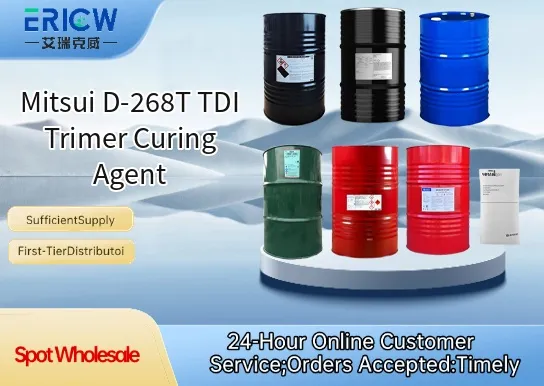
Highly stable aliphatic trimer structure ensures excellent storage stability and extended pot life.
Low volatility and reduced monomer content enhance workplace safety and compliance with industrial hygiene standards.
Delivers superior hardness, chemical resistance, and UV stability in cured polyurethane coatings and adhesives.
Compatible with a wide range of polyols including polyester, polyether, and acrylic types for flexible formulation design.
Enables rapid cure at ambient or elevated temperatures without requiring strong catalysts.
High-performance automotive clearcoats and basecoats.
Durable industrial maintenance coatings for metal and concrete substrates.
Two-component polyurethane adhesives for transportation and composite bonding.
UV-resistant architectural coatings for façades and cladding systems.
Flexible elastomeric sealants requiring low-temperature flexibility and weather resistance.
| Chemical Type | TDI-based isocyanurate trimer |
| Product Form | Liquid |
| Appearance | Clear to pale yellow viscous liquid |
| NCO Content (wt%) | 19.5–20.5% |
| Viscosity (mPa·s, 25°C) | 800–1,200 |
| Specific Gravity (25°C) | 1.18–1.22 |
| Monomeric TDI Content | <0.5% (w/w) |
| Storage Stability | ≥12 months at 25°C in sealed container |
Q1: What is the primary function of Mitsui D-268T in polyurethane systems?
A: Mitsui D-268T is a trifunctional aromatic isocyanurate-based curing agent derived from toluene diisocyanate (TDI), designed to react with hydroxyl-terminated resins—such as polyols or acrylic polyols—to form highly crosslinked, thermoset polyurethane networks with enhanced chemical resistance, hardness, and thermal stability.
Q2: Is D-268T compatible with aliphatic polyol systems for non-yellowing coatings?
A: While D-268T is aromatic and may contribute to yellowing under UV exposure, it can be formulated into hybrid or semi-aliphatic systems where performance requirements prioritize cure speed and film integrity over long-term UV stability; for fully non-yellowing applications, aliphatic isocyanurate alternatives are typically preferred.
Q3: How does D-268T compare to HDI-based trimer curing agents in terms of reactivity and pot life?
A: As an aromatic TDI trimer, D-268T exhibits higher intrinsic reactivity toward hydroxyl groups than aliphatic HDI trimers, enabling faster ambient or low-bake cure profiles; however, this also results in a shorter pot life when blended with reactive resins, requiring careful formulation and process timing control.
Q4: What solvent compatibility should be considered when formulating with D-268T?
A: D-268T is readily soluble in common organic solvents including acetates (e.g., ethyl acetate), ketones (e.g., methyl isobutyl ketone), and aromatic hydrocarbons (e.g., xylene); it has limited compatibility with highly polar protic solvents such as water or low-molecular-weight alcohols, which may induce premature reaction or haze formation.
Contact With Us:
E-mail: wangxingqiang@ericwchem.com
Have a Questions? Call Us:
Add:
Building A1, Jiete Industrial Park, Huangpu District, Guangzhou City, Guangdong Province, China