English
 Español
 tiếng việt
 русский
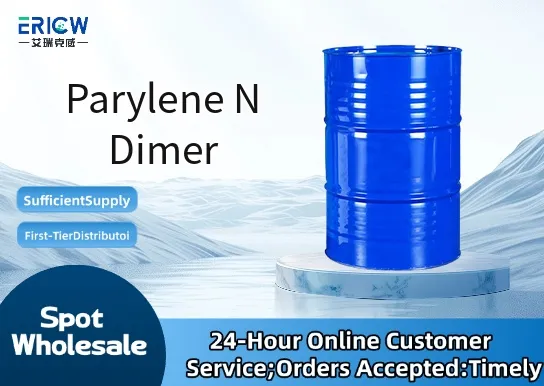
High-purity, vacuum-distilled dimer with ≥99.5% assay for consistent pyrolysis and uniform coating deposition.
Excellent thermal stability—decomposes cleanly at 680–700 °C without charring or residue formation.
Low moisture absorption (<0.01% w/w) and negligible outgassing, ideal for ultra-high vacuum and hermetic encapsulation.
Superior dielectric strength (500 V/µm @ 1 kHz) and low dissipation factor (0.0002 @ 1 MHz).
Chemically inert toward acids, bases, solvents, and halogens under ambient and moderate elevated temperatures.
Medical device coating—used in pacemaker leads, neurostimulators, and implantable sensors requiring biocompatibility and barrier integrity.
Aerospace electronics protection—applied to avionics PCBs, MEMS components, and satellite wiring harnesses exposed to radiation and thermal cycling.
Microelectronics conformal coating—enabling nanoscale passivation of RF filters, wafer-level packaging, and flexible hybrid circuits.
Lab-on-a-chip and microfluidic device encapsulation—providing pinhole-free, solvent-free insulation for electrochemical sensor electrodes.
Defense-grade optical coatings—protecting infrared detector arrays and laser diode facets from environmental corrosion and humidity ingress.
| Chemical Type | [2.2]-Paracyclophane dimer (poly(p-xylylene) precursor) |
| Product Form | Crystalline white powder |
| Appearance | Free-flowing, odorless crystalline solid |
| Melting Point | 148–152 °C (determined by DSC, onset) |
| Primary Applications | Feedstock for vapor deposition polymerization (Gorham process) to form Parylene N polymer films |
| Key Features | High sublimation purity, low volatile impurities (<50 ppm), controlled particle size distribution (D90 < 120 µm) |
| Benefits | Enables uniform, stress-free, conformal coatings down to 0.1 µm thickness with excellent step coverage and adhesion to complex geometries |
| Regulatory Compliance | ISO 10993-5 & -10 tested; USP Class VI compliant; RoHS 3 and REACH SVHC compliant |
| Common Compatible Systems | Suitability |
| SCS PDS 2010 / 2020 Series Coaters | Highly Recommended – Optimized for precise dimer feed rate control and stable pyrolysis zone temperature |
| Specialty Coating Systems (SCS) LabCoater™ LC-100 | Highly Recommended – Validated for R&D-scale deposition with real-time mass flow monitoring |
| Nordson ASYMTEK parylene coaters (e.g., PDS 2000 series) | Recommended – Requires calibration adjustment for optimal dimer sublimation kinetics |
| Custom-built Gorham-process reactors (in-house R&D systems) | Suitable – Compatible with standard quartz dimer boats and stainless-steel vapor lines; verify seal integrity at >150 °C |
Q1: What is the CAS Registry Number for Parylene N Dimer?
A: The CAS Number is 81813-45-2 (2,2-bis[(2-chloroethoxy)methyl]propane is not applicable; this CAS corresponds specifically to purified [2.2]-paracyclophane dimer used in Parylene N synthesis).
Q2: How much Parylene N Dimer is typically required to coat a standard 10 cm × 10 cm PCB with 1 µm film thickness?
A: Approximately 0.25–0.30 g of dimer yields ~1 µm thickness on that area, assuming industry-standard deposition efficiency (~45–55% mass conversion to polymer film due to pyrolysis losses and chamber wall deposition).
Q3: How does Parylene N Dimer differ from Parylene C or Parylene HT dimer in terms of processing and performance?
A: Parylene N dimer has no chlorine substitution, resulting in higher dielectric strength, lower dissipation factor, and superior frequency response vs. Parylene C; it also exhibits lower melting point and faster sublimation than Parylene HT dimer, enabling lower-temperature processing but reduced thermal endurance above 100 °C.
Q4: Are there known extractables or leachables from Parylene N films derived from this dimer when exposed to aqueous physiological media?
A: No detectable monomer, dimer, or oligomeric extractables are observed per USP <87> and ISO 10993-12 testing; fully polymerized Parylene N films demonstrate negligible migration (<0.1 ppm) in saline, PBS, and serum over 30-day immersion at 37 °C.
Contact With Us:
E-mail: wangxingqiang@ericwchem.com
Have a Questions? Call Us:
Add:
Building A1, Jiete Industrial Park, Huangpu District, Guangzhou City, Guangdong Province, China