English
 Español
 tiếng việt
 русский
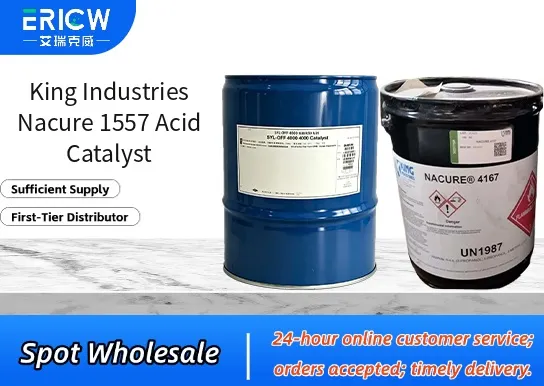
Highly effective low-temperature curing accelerator for amino-formaldehyde resins.
Provides excellent storage stability in solvent-based and high-solids coating formulations.
Minimizes formaldehyde emission during cure compared to traditional strong acid catalysts.
Enables rapid through-cure without surface over-bake or yellowing in thermosetting coatings.
Compatible with melamine, urea, and phenolic crosslinkers in industrial coil and can coatings.
Automotive OEM and refinish topcoats requiring fast, low-temperature bake cycles.
Industrial coil coatings for pre-painted metal substrates.
Food-can and beverage-can interior and exterior enamel systems.
Appliance coatings where color retention and gloss stability are critical.
General-purpose thermosetting industrial maintenance coatings.
| Chemical Type | Encapsulated sulfonic acid derivative |
| Product Form | Free-flowing white to off-white powder |
| Appearance | Granular solid, non-hygroscopic |
| Primary Applications | Amino resin crosslinking in thermosetting coatings |
| Key Features | Latent acid activation; thermal deprotection above 120°C |
| Benefits | Extended pot life, reduced VOC impact, improved film integrity |
| Recommended Use Level | 0.5–2.0 wt% on total resin solids |
| Storage Conditions | Keep sealed in cool, dry place; stable up to 24 months |
Q1: What is the primary function of Nacure 1557 in coating and ink formulations?
A: Nacure 1557 is a latent acid catalyst designed to promote efficient crosslinking of melamine-formaldehyde and other amino resins at elevated temperatures. It remains inactive at ambient conditions, enabling extended pot life and improved formulation stability before cure.
Q2: How does Nacure 1557 compare to traditional strong acid catalysts in terms of handling and safety?
A: Unlike volatile or highly corrosive mineral acids, Nacure 1557 is a non-volatile, solid organic acid derivative with lower volatility and reduced handling hazards. It offers improved operator safety and reduced odor during processing while maintaining effective catalytic activity upon thermal activation.
Q3: Is Nacure 1557 compatible with waterborne systems?
A: Yes, Nacure 1557 demonstrates good compatibility with many waterborne acrylic, polyester, and hybrid resin systems. Its solubility and dispersion behavior may vary depending on pH, co-solvent selection, and ionic content—formulators are advised to conduct compatibility testing under representative conditions.
Q4: What is the typical dosage range for optimal performance?
A: Dosage depends on resin type, film thickness, cure schedule, and desired balance of storage stability and cure speed. Nacure 1557 is typically used at low concentrations—generally ranging from 0.1% to 2% by weight relative to total resin solids—and should be optimized empirically for each system.
Contact With Us:
E-mail: wangxingqiang@ericwchem.com
Have a Questions? Call Us:
Add:
Building A1, Jiete Industrial Park, Huangpu District, Guangzhou City, Guangdong Province, China