English
 Español
 tiếng việt
 русский
High transparency and excellent optical clarity for premium visual performance.
Outstanding weather resistance, including UV stability and minimal yellowing after prolonged outdoor exposure.
Good melt processability suitable for extrusion, injection molding, and thermoforming operations.
Excellent compatibility with common plasticizers and other acrylic-based resins for formulation flexibility.
Low inherent viscosity enabling easy handling in solvent-based coating and adhesive systems.
Automotive interior trim coatings requiring gloss retention and scratch resistance.
Outdoor signage and light-diffusing panels where long-term color stability is critical.
Protective overcoats for metal and plastic substrates in architectural and industrial applications.
Transparent films and sheets for display components and optical light guides.
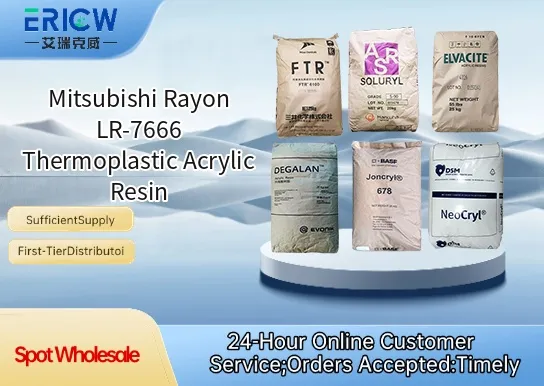
| Chemical Type | Thermoplastic acrylic copolymer |
| Product Form | Pellets |
| Appearance | White to slightly yellow translucent pellets |
| Primary Applications | Coatings, films, molded parts, and transparent functional layers |
| Key Features | UV resistance, optical clarity, thermal processability, solvent solubility |
| Benefits | Reduced formulation complexity, improved durability under environmental stress, compatibility with standard processing equipment |
| Solvent Solubility | Soluble in methyl ethyl ketone (MEK), acetone, toluene, and chlorinated hydrocarbons |
| Storage Conditions | Store in cool, dry place away from direct sunlight and moisture |
Q1: What is the primary function of LR-7666 in thermoplastic formulations?
A: LR-7666 serves as a high-clarity, low-viscosity thermoplastic acrylic resin used primarily to enhance surface hardness, gloss retention, and weatherability in solvent-based coatings and specialty polymer blends. It functions as a film-forming binder or modifier rather than a crosslinker.
Q2: Is LR-7666 compatible with common thermoplastic polymers such as ABS, PC, or PMMA?
A: Yes, LR-7666 exhibits good compatibility with a range of engineering thermoplastics including ABS, polycarbonate (PC), and poly(methyl methacrylate) (PMMA), particularly in applications requiring improved melt flow, surface finish, or UV stability. Compatibility should be verified experimentally for specific processing conditions and ratios.
Q3: How is LR-7666 typically processed in industrial applications?
A: LR-7666 is commonly incorporated via solvent blending, hot-melt compounding, or extrusion. It dissolves readily in common organic solvents such as methyl ethyl ketone (MEK), toluene, and xylene, and can be melt-processed at temperatures compatible with standard thermoplastic equipment—typically below 220 °C to avoid thermal degradation.
Q4: Does LR-7666 require additional curing agents or catalysts?
A: No—LR-7666 is a non-reactive, thermoplastic acrylic resin and does not undergo chemical crosslinking. It forms films through physical cooling or solvent evaporation and does not require curing agents, peroxides, or catalysts under standard use conditions.
Contact With Us:
E-mail: wangxingqiang@ericwchem.com
Have a Questions? Call Us:
Add:
Building A1, Jiete Industrial Park, Huangpu District, Guangzhou City, Guangdong Province, China