English
 Español
 tiếng việt
 русский
Excellent mechanical strength and dimensional stability after curing.
Good compatibility with standard styrene monomers and common free-radical initiators.
Low viscosity for enhanced fiber wet-out and improved processability in RTM and hand lay-up operations.
Superior chemical resistance to water, dilute acids, and alkalis under ambient conditions.
Consistent batch-to-batch performance meeting ISO 9001-certified manufacturing standards.
Fiberglass-reinforced plastic (FRP) tanks and vessels for industrial corrosion protection.
Composite panels and structural profiles for building and construction applications.
Marine components including boat hulls, decks, and fairings.
Transportation parts such as truck body panels and bus interior trim.
Electrical insulation components requiring flame-retardant formulations (when compounded with ATH).
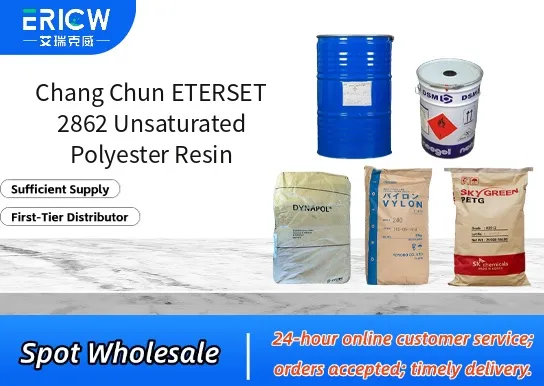
| Chemical Type | Unsaturated polyester resin (bisphenol-A/fumaric acid modified) |
| Product Form | Liquid, ready-to-use solution |
| Appearance | Clear, pale yellow to amber viscous liquid |
| Viscosity (25°C) | 350–450 mPa·s (Brookfield DV-II+ @ 20 rpm) |
| Solid Content | ≈99.5% (non-volatile) |
| Acid Value | 18–22 mg KOH/g |
| Gel Time (100 g + 1% MEKP at 25°C) | 12–16 minutes |
| Primary Applications | FRP laminating, casting, and pultrusion |
Q1: What are the primary end-use applications for ETERSET 2862?
A: ETERSET 2862 is commonly employed in structural and semi-structural composite manufacturing, including pultrusion profiles, filament-wound tanks and pipes, and reinforced panels where balanced mechanical performance, good gel time control, and moderate heat resistance are required.
Q2: Which initiators are typically recommended for curing ETERSET 2862?
A: This resin responds well to standard organic peroxide initiators such as methyl ethyl ketone peroxide (MEKP) for ambient or elevated temperature cure. Selection of initiator type and concentration should be optimized based on processing method, part thickness, and desired gel and cure profile.
Q3: How does ETERSET 2862 compare to general-purpose unsaturated polyester resins in terms of viscosity and reactivity?
A: ETERSET 2862 exhibits a moderately low to medium viscosity at room temperature, facilitating good fiber wet-out in reinforcement systems. Its reactivity is tuned for controlled gel times—typically longer than highly reactive orthophthalic resins but shorter than some vinyl ester alternatives—supporting reliable process window management in continuous operations.
Q4: Is ETERSET 2862 suitable for use with low-profile additives and fillers?
A: Yes, ETERSET 2862 demonstrates good compatibility with common low-profile additives (e.g., thermoplastic polymers), calcium carbonate, and talc fillers, enabling formulation of composites with reduced shrinkage and improved surface finish—subject to proper dispersion and compatibility testing in the final system.
Contact With Us:
E-mail: wangxingqiang@ericwchem.com
Have a Questions? Call Us:
Add:
Building A1, Jiete Industrial Park, Huangpu District, Guangzhou City, Guangdong Province, China