English
 Español
 tiếng việt
 русский
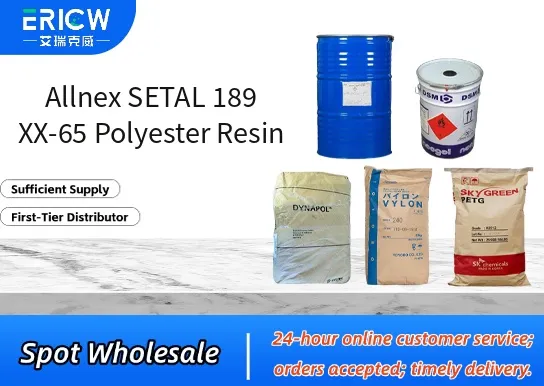
High-solids, low-viscosity unsaturated polyester resin for efficient processing and reduced VOC emissions.
Excellent compatibility with styrene and standard free-radical initiators used in thermoset systems.
Good mechanical strength and dimensional stability after curing, suitable for structural composites.
Consistent batch-to-batch performance ensured by Allnex’s stringent quality control and ISO-certified manufacturing.
Optimized reactivity profile for reliable gel time and cure response across ambient and elevated temperature conditions.
Fiberglass-reinforced plastic (FRP) tanks and vessels for chemical storage and transport.
Automotive body panels and under-hood components requiring thermal resistance and impact performance.
Marine deck laminates and hull structures where moisture resistance and long-term durability are critical.
Industrial grating and corrosion-resistant ducting in wastewater treatment and process plants.
Wind turbine blade subcomponents and nacelle housings leveraging balanced stiffness and toughness.
| Chemical Type | Unsaturated polyester resin |
| Product Form | Liquid |
| Appearance | Clear to slightly hazy, pale yellow liquid |
| Primary Applications | Structural composites, FRP laminates, castings |
| Key Features | High solids content, low styrene demand, good wet-out |
| Benefits | Improved productivity, lower emissions, enhanced fiber impregnation |
| Storage Conditions | Store below 25°C, protect from freezing and direct sunlight |
| Shelf Life | 6 months from date of manufacture when stored properly |
Q1: What is the primary application of SETAL 189 XX-65 in coating systems?
A: SETAL 189 XX-65 is a solvent-based, medium-molecular-weight unsaturated polyester resin designed primarily for high-gloss, durable thermoset coatings—especially in coil and metal decorating applications where excellent flow, leveling, and overbake resistance are required.
Q2: Is SETAL 189 XX-65 compatible with common crosslinkers used in polyester-based coil coatings?
A: Yes, it is formulated to be compatible with standard amino resins such as melamine-formaldehyde crosslinkers, and performs well in conventional baking cycles typical for coil coating lines. Compatibility and cure response should be verified in the final formulation under actual processing conditions.
Q3: How does SETAL 189 XX-65 contribute to film performance in terms of flexibility and hardness?
A: It offers a balanced profile—providing good substrate adhesion and bendability on cold-formed metal substrates while maintaining sufficient hardness and mar resistance after full cure, making it suitable for demanding post-forming applications.
Q4: Can SETAL 189 XX-65 be used in low-VOC or high-solids formulations?
A: While originally developed for conventional solvent-borne systems, it can be adapted into higher-solids formulations through solvent selection and viscosity adjustment. However, its suitability for regulatory-compliant low-VOC systems depends on the full formulation—including solvents, crosslinkers, and additives—and must be evaluated case by case.
Contact With Us:
E-mail: wangxingqiang@ericwchem.com
Have a Questions? Call Us:
Add:
Building A1, Jiete Industrial Park, Huangpu District, Guangzhou City, Guangdong Province, China