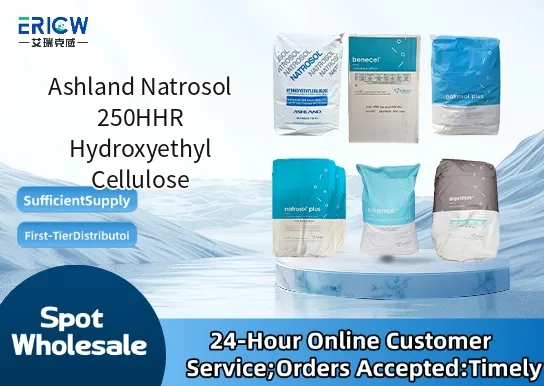
Features Of Ashland Natrosol 250HHR Hydroxyethyl Cellulose
High-viscosity, water-soluble polymer offering excellent thickening efficiency in aqueous systems.
Enhanced rheology control with outstanding suspension and anti-settling performance for particulates.
Good compatibility with electrolytes, surfactants, and common industrial additives.
pH-stable across broad range (pH 3–11), maintaining consistent viscosity under varying formulation conditions.
Non-ionic character ensures low sensitivity to hard water and minimal interaction with cationic agents.
Typical Applications Of Ashland Natrosol 250HHR Hydroxyethyl Cellulose
Architectural coatings — providing sag resistance, brush/roller drag control, and spatter reduction.
Tile adhesives and cement-based mortars — improving workability, water retention, and open time.
Agrochemical suspensions — enabling stable suspension of active ingredients and preventing sedimentation.
Personal care formulations — delivering elegant rheology and sensory profile in shampoos and gels.
Specifications Of Ashland Natrosol 250HHR Hydroxyethyl Cellulose
| Chemical Type | Hydroxyethyl cellulose (HEC) |
| Product Form | Free-flowing white to off-white powder |
| Appearance | Odorless, fine granular powder |
| Primary Applications | Water-based paints, construction mortars, agrochemicals, personal care |
| Key Features | High molecular weight, high viscosity grade, non-ionic, cold-water dispersible |
| Benefits | Improved thickening efficiency, enhanced suspension stability, extended open time, pH robustness |
| Solubility | Readily dispersible in cold water; forms clear, viscous solutions upon hydration |
Ashland Natrosol 250HHR Hydroxyethyl Cellulose – Frequently Asked Questions (FAQ)
Q1: What distinguishes Natrosol 250HHR from other hydroxyethyl cellulose (HEC) grades?
A: Natrosol 250HHR is a high-hydrophobic-substitution HEC grade engineered for enhanced rheology control in challenging formulations—particularly those containing surfactants, electrolytes, or organic solvents. Its modified substitution pattern provides improved thickening efficiency and better suspension stability under shear and temperature fluctuations compared to standard HEC grades.
Q2: Is Natrosol 250HHR suitable for use in water-based architectural coatings?
A: Yes—it is widely used in interior and exterior latex paints and primers to provide excellent sag resistance, brush/roller drag control, and spatter reduction. It delivers robust viscosity build at low shear while maintaining good flow and leveling at high shear, supporting both performance and application efficiency.
Q3: How should Natrosol 250HHR be dispersed to avoid clumping or fisheyes?
A: For optimal dispersion, pre-wet the powder with a water-miscible liquid (e.g., glycol or ethanol) or add it slowly under high-shear mixing into the aqueous phase. Avoid direct addition to cold, stagnant water. Hydration is typically complete within minutes at ambient temperature, though full viscosity development may require 15–30 minutes depending on pH and formulation complexity.
Q4: Does Natrosol 250HHR offer compatibility with common biocides and defoamers?
A: Yes—it demonstrates broad compatibility with isothiazolinone and formaldehyde-releasing biocides, as well as silicone- and mineral oil–based defoamers commonly used in industrial and architectural coatings. As with any formulation, compatibility testing under intended processing and storage conditions is recommended.
 English
 Español
 tiếng việt
 русский