English
 Español
 tiếng việt
 русский
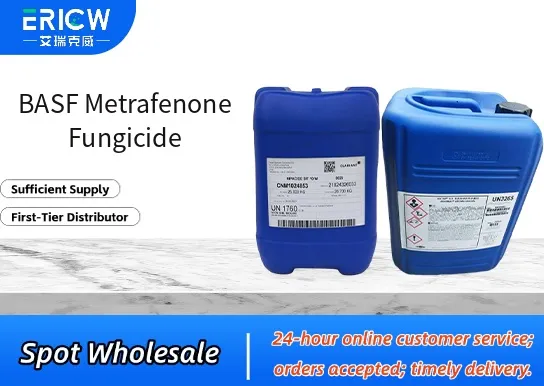
Highly effective against key powdery mildew pathogens, including *Podosphaera leucotricha* and *Erysiphe necator*.
Unique mode of action (FRAC Group U6) with no known cross-resistance to other fungicide classes.
Excellent preventive and early curative activity, supporting robust disease management programs.
Good rainfastness and favorable environmental profile, including low toxicity to beneficial arthropods.
Compatible with integrated pest management (IPM) and resistance management strategies.
Vineyards — control of grapevine powdery mildew (*Erysiphe necator*).
Apple orchards — suppression of apple powdery mildew (*Podosphaera leucotricha*).
Strawberry production — management of strawberry powdery mildew (*Podosphaera aphanis*).
Cucumber and other cucurbit crops — protection against cucurbit powdery mildew (*Podosphaera xanthii*).
Protected horticulture (greenhouses and tunnels) — targeted use in high-value vegetable and berry systems.
| Chemical Type | Strobilurin-like fungicide (FRAC Group U6) |
| Active Ingredient | Metrafenone (97.5% technical grade) |
| Product Form | Wettable granule (WG) |
| Appearance | Off-white to light beige granular solid |
| Solubility in Water | Low (0.42 mg/L at 20°C) |
| Stability | Stable under normal storage conditions (≤30°C, dry, shaded) |
| Primary Applications | Fruit, vine, vegetable, and ornamental crops |
| Key Regulatory Status | Approved in EU, USA, Canada, Australia, and multiple APAC markets |
Q1: What is the primary mode of action of metrafenone?
A: Metrafenone is a highly selective, contact-and-penetration fungicide that inhibits fungal cell wall biosynthesis by interfering with chitin assembly and glucan synthesis—particularly effective against powdery mildew pathogens in a range of horticultural and field crops.
Q2: Which crop types is BASF Metrafenone Fungicide typically registered for use on?
A: It is widely approved for use on grapevines, cucurbits, strawberries, apples, pears, and ornamental plants—primarily targeting Erysiphales species. Registration status varies by region, and users must consult local regulatory authorities before application.
Q3: Is metrafenone compatible with common tank-mix partners such as strobilurins or triazoles?
A: Yes, metrafenone generally demonstrates good physical and biological compatibility with many broad-spectrum fungicides—including azoles and QoIs—when used according to label instructions. However, compatibility testing under actual field conditions is recommended prior to large-scale mixing.
Q4: How does metrafenone contribute to resistance management strategies?
A: Due to its unique biochemical target site and low cross-resistance risk with major fungicide classes, metrafenone serves as a valuable rotation or mixture partner in anti-resistance programs—especially where powdery mildew populations have developed reduced sensitivity to demethylation inhibitors (DMIs) or quinone outside inhibitors (QoIs).
Q5: In what formulation types is BASF Metrafenone Fungicide commercially supplied?
A: BASF supplies metrafenone as a high-purity technical active ingredient (TC), suitable for incorporation into wettable powders (WP), suspension concentrates (SC), and water-dispersible granules (WDG). Final formulation design depends on end-use requirements and regional regulatory specifications.
Contact With Us:
E-mail: wangxingqiang@ericwchem.com
Have a Questions? Call Us:
Add:
Building A1, Jiete Industrial Park, Huangpu District, Guangzhou City, Guangdong Province, China