English
 Español
 tiếng việt
 русский
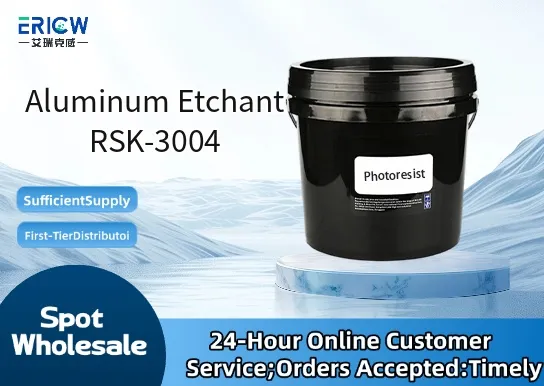
Highly selective etching for aluminum and aluminum alloys with minimal undercutting.
Non-hydrofluoric acid (HF-free) formulation ensuring improved workplace safety and reduced regulatory burden.
Stable performance across a broad temperature range (20–50 °C) without rapid decomposition or gas evolution.
Compatible with common photoresists and masking materials used in precision metal patterning.
Low metal ion contamination risk, supporting high-purity requirements in electronics and aerospace applications.
Microfabrication of aluminum interconnects and bonding pads in semiconductor packaging.
Etching of aluminum heat sinks and thermal management components in power electronics.
Surface texturing and controlled thickness reduction of aluminum foils for battery current collectors.
Manufacturing of microfluidic device substrates with integrated aluminum electrodes.
Precision patterning of decorative and functional aluminum layers on architectural cladding panels.
| Chemical Type | Acidic aqueous solution (phosphoric-nitric based) |
| Product Form | Liquid concentrate (ready-to-dilute) |
| Appearance | Clear, pale yellow to amber liquid |
| pH (as supplied) | 1.2–1.8 (25 °C) |
| Primary Applications | Wet chemical etching of aluminum, Al-Mg, Al-Si, and Al-Cu alloys |
| Key Features | HF-free, low fuming, stable shelf life (>12 months unopened) |
| Benefits | Reduced PPE requirements, simplified waste neutralization, consistent etch rate control |
| Regulatory Compliance | REACH compliant; SDS available per EU/OSHA standards; not classified as hazardous for transport (UN3082 exempt under certain dilutions) |
| Common Compatible Systems | Suitability |
| Standard immersion tanks with PP or PVC construction | Highly Recommended – Chemically inert and thermally stable up to 60 °C |
| Recirculating spray etch systems (stainless steel 316L-lined) | Recommended – Requires continuous filtration and pH monitoring |
| Automated batch processing lines with resist stripper integration | Suitable – Compatible with common alkaline and solvent-based strippers when rinsed thoroughly |
| Ultrasonic-assisted etching baths (37–45 kHz) | Recommended – Enhances uniformity on complex geometries without accelerating corrosion |
Q1: What is the CAS Registry Number for Aluminum Etchant RSK-3004?
A: RSK-3004 is a proprietary multi-component formulation; individual ingredients are listed on the Safety Data Sheet (SDS), but the blend itself does not carry a single CAS number. Key constituents include phosphoric acid (CAS 7664-38-2) and nitric acid (CAS 7697-37-2).
Q2: What is the recommended working concentration and typical etch rate?
A: Dilute 1:4 to 1:9 (v/v) with deionized water. At 30 °C, etch rate on pure aluminum (1050) ranges from 0.3–0.8 µm/min depending on agitation and alloy composition.
Q3: How does RSK-3004 compare to traditional HF-containing aluminum etchants?
A: RSK-3004 eliminates acute toxicity and dermal penetration risks associated with HF, simplifies ventilation and spill response, and avoids silicon dioxide attack — making it ideal for etching aluminum over SiO₂ passivation layers without mask degradation.
Q4: Is RSK-3004 compliant with RoHS 3 and REACH SVHC requirements?
A: Yes — RSK-3004 contains no substances listed on the current REACH SVHC Candidate List and fully complies with RoHS 3 (2015/863/EU) restrictions on lead, cadmium, mercury, hexavalent chromium, PBBs, PBDEs, and the four phthalates.
Q5: Does RSK-3004 pose any migration or leaching risk into food-contact or pharmaceutical surfaces?
A: When used strictly per validated process parameters and followed by thorough DI water rinse and neutralization (e.g., dilute sodium carbonate), residual extractables fall below FDA 21 CFR §175.300 limits for indirect food contact coatings. Full validation is required for specific substrate/rinse protocols.
Contact With Us:
E-mail: wangxingqiang@ericwchem.com
Have a Questions? Call Us:
Add:
Building A1, Jiete Industrial Park, Huangpu District, Guangzhou City, Guangdong Province, China