English
 Español
 tiếng việt
 русский
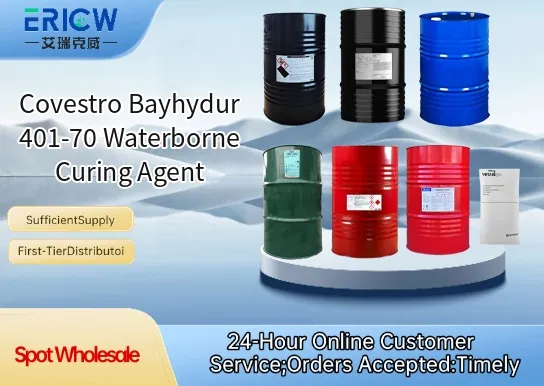
Waterborne aliphatic polyisocyanate dispersion with low VOC content, compliant with stringent environmental regulations.
Excellent hydrolytic stability and storage stability in aqueous systems, enabling extended shelf life.
Fast ambient-cure kinetics when paired with waterborne polyols, supporting efficient production cycles.
Delivers outstanding gloss retention, UV resistance, and weathering performance in final coatings.
Low free monomer content (<0.1% HDI), enhancing occupational safety and regulatory compliance.
Architectural and industrial maintenance coatings requiring high durability and low odor.
Automotive refinish coatings where waterborne technology meets OEM performance standards.
Wood coatings for furniture and cabinetry demanding clarity, hardness, and scratch resistance.
Plastic coatings for automotive interior parts and consumer electronics housings.
General-purpose protective coatings for metal substrates in infrastructure and equipment applications.
| Chemical Type | Aliphatic polyisocyanate (HDI-based) dispersion |
| Product Form | Opaque white to slightly yellow liquid |
| Appearance | Homogeneous aqueous dispersion |
| Solids Content (wt %) | 45–47% |
| pH (at 23 °C) | 7.0–8.5 |
| Viscosity (mPa·s, 23 °C) | 150–350 |
| NCO Content (wt %) | 6.5–7.2% |
| Free HDI Monomer (wt %) | <0.1% |
Q1: What is the primary chemical composition of Bayhydur 401-70?
A: Bayhydur 401-70 is a water-dispersible aliphatic polyisocyanate based on hexamethylene diisocyanate (HDI) trimer chemistry, modified with hydrophilic groups to enable stable dispersion in aqueous systems without added organic solvents or surfactants.
Q2: Can Bayhydur 401-70 be used in direct-to-metal (DTM) waterborne coatings?
A: Yes — it is specifically designed for high-performance waterborne two-component (2K) coatings, including DTM applications. Its low viscosity and excellent compatibility with acrylic and polyurethane dispersions support good film formation, corrosion resistance, and substrate wetting on metals.
Q3: How does Bayhydur 401-70 compare to solvent-based HDI trimers in terms of pot life and curing speed?
A: It offers extended pot life compared to many conventional waterborne isocyanates due to its stabilized dispersion and controlled reactivity. Cure speed remains robust at ambient and elevated temperatures, though full crosslink development may require slightly longer than highly reactive solvent-borne analogues — especially under high-humidity conditions.
Q4: Is Bayhydur 401-70 compatible with common waterborne resins such as acrylics, polyester dispersions, and hybrid systems?
A: Yes — it demonstrates broad compatibility with a wide range of anionic and non-ionic waterborne resins, including acrylic, polyester, polyurethane, and hybrid dispersions. Compatibility testing under actual formulation conditions is recommended to optimize stability and performance.
Contact With Us:
E-mail: wangxingqiang@ericwchem.com
Have a Questions? Call Us:
Add:
Building A1, Jiete Industrial Park, Huangpu District, Guangzhou City, Guangdong Province, China