English
 Español
 tiếng việt
 русский
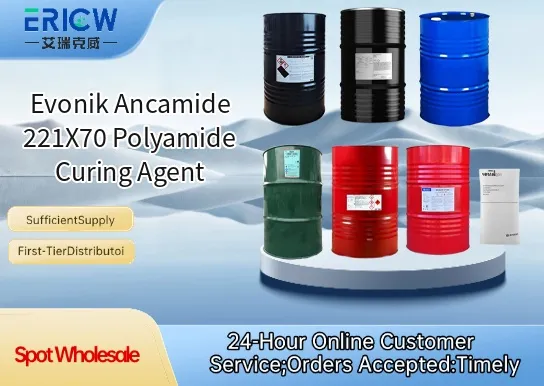
Low-viscosity liquid polyamide offering excellent compatibility with epoxy resins.
Enables room-temperature curing with good pot life and extended working time.
Delivers high flexibility, impact resistance, and adhesion to diverse substrates.
Provides superior chemical resistance, particularly to alkalis and solvents.
Halogen-free formulation supporting sustainable and regulatory-compliant formulations.
Industrial maintenance coatings for steel and concrete infrastructure.
Electrical encapsulation and potting compounds for transformers and busbars.
Adhesives and sealants requiring toughness and environmental durability.
Marine and offshore protective coatings exposed to humid and saline conditions.
Repair mortars and grouts for civil engineering and structural rehabilitation.
| Chemical Type | Polyamide adduct |
| Product Form | Clear to pale yellow liquid |
| Appearance | Homogeneous, low-viscosity liquid |
| Amine Value | 340–380 mg KOH/g |
| Viscosity (25°C) | 800–1,200 mPa·s |
| Density (20°C) | 0.96–0.99 g/cm³ |
| Primary Applications | Epoxy resin curing for coatings, adhesives, and composites |
| Key Features | Room-temperature cure, flexibility, chemical resistance, halogen-free |
Q1: What is the primary function of Ancamide 221X70 in epoxy systems?
A: Ancamide 221X70 is a polyamide-based curing agent designed to react with epoxy resins, enabling crosslinking and development of mechanical strength, chemical resistance, and thermal stability in the final cured film or composite.
Q2: Is Ancamide 221X70 suitable for ambient-cure applications?
A: Yes — it is formulated to provide effective curing at room temperature, making it well-suited for coatings, adhesives, and repair compounds where elevated oven temperatures are impractical or undesirable.
Q3: How does Ancamide 221X70 compare to conventional aliphatic polyamide curing agents in terms of flexibility and toughness?
A: It offers enhanced flexibility and impact resistance compared to many standard polyamides, supporting formulations that require durable yet deformable cured networks — especially beneficial in industrial maintenance coatings and structural bonding applications.
Q4: What types of epoxy resins is Ancamide 221X70 typically compatible with?
A: It demonstrates good compatibility with a broad range of liquid and solid bisphenol-A and bisphenol-F based epoxy resins, as well as modified epoxies such as novolac and cycloaliphatic types — though optimal performance requires formulation-specific evaluation.
Q5: How should Ancamide 221X70 be stored to maintain its reactivity and shelf life?
A: Store in original sealed containers under dry, cool conditions (preferably below 30 °C) and protected from moisture and direct sunlight; exposure to humidity may lead to viscosity increase or reduced curing activity over time.
Contact With Us:
E-mail: wangxingqiang@ericwchem.com
Have a Questions? Call Us:
Add:
Building A1, Jiete Industrial Park, Huangpu District, Guangzhou City, Guangdong Province, China