English
 Español
 tiếng việt
 русский
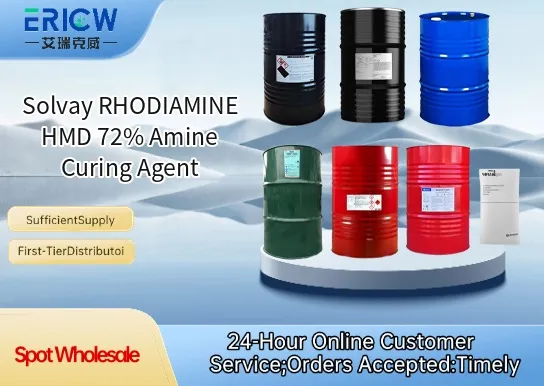
High reactivity with epoxy resins enabling rapid cure at ambient or moderate elevated temperatures.
Excellent chemical resistance and thermal stability in cured epoxy systems.
Low volatility and favorable handling properties due to its liquid formulation and controlled amine content.
Consistent batch-to-batch performance supported by Solvay’s stringent quality control protocols.
Compatible with standard epoxy formulations including bisphenol-A, bisphenol-F, and novolac resins.
Structural adhesives for aerospace and automotive bonding applications.
Electrical encapsulation and potting compounds requiring high dielectric strength.
High-performance composite matrices in wind turbine blades and industrial tooling.
Coatings for corrosion protection in oil & gas and marine infrastructure.
Underfill and molding compounds in electronics packaging.
| Chemical Type | Hexamethylenediamine (HMD)-based aliphatic amine |
| Product Form | Liquid |
| Appearance | Clear, pale yellow liquid |
| Amine Content | 72% w/w (as supplied) |
| Density (20 °C) | 0.90–0.93 g/cm³ |
| Viscosity (25 °C) | 80–120 mPa·s |
| pH (10% aqueous solution) | 11.0–11.8 |
| Storage Stability | ≥12 months at 15–25 °C in sealed containers |
Q1: What is the primary function of RHODIAMINE HMD 72% in epoxy systems?
A: RHODIAMINE HMD 72% serves as a highly reactive aliphatic amine curing agent, enabling rapid ambient- or elevated-temperature crosslinking of epoxy resins to deliver excellent mechanical strength, chemical resistance, and adhesion—particularly suited for high-performance coatings, composites, and structural adhesives.
Q2: How does the 72% active amine content affect formulation handling and performance?
A: The 72% concentration reflects the nominal active amine content in a stabilized liquid formulation, balancing reactivity with viscosity and shelf life. It allows for efficient stoichiometric adjustment while maintaining favorable processing characteristics—such as reduced mixing viscosity and improved pot life control—compared to higher-concentration or solid alternatives.
Q3: Is RHODIAMINE HMD compatible with standard bisphenol-A and bisphenol-F epoxy resins?
A: Yes, RHODIAMINE HMD demonstrates broad compatibility with conventional liquid and solid epoxy resins, including DGEBA and DGEBF types. It delivers consistent cure profiles and final properties across diverse resin molecular weights and functionalities, though optimal performance requires verification under specific formulation and cure conditions.
Q4: What safety and handling precautions should be observed during use?
A: As a reactive amine, RHODIAMINE HMD may cause skin sensitization and respiratory irritation. Users must wear appropriate PPE—including nitrile gloves, chemical-resistant goggles, and adequate ventilation—and consult the current Safety Data Sheet (SDS) for detailed exposure controls, first-aid measures, and disposal guidance prior to handling.
Q5: Can RHODIAMINE HMD be used in applications requiring low-temperature cure capability?
A: Yes—RHODIAMINE HMD exhibits good reactivity at ambient temperatures and can achieve functional cure even below 15°C, making it suitable for field-applied coatings and repair systems where heated ovens are unavailable. Full property development, however, typically benefits from post-cure at moderate temperatures.
Contact With Us:
E-mail: wangxingqiang@ericwchem.com
Have a Questions? Call Us:
Add:
Building A1, Jiete Industrial Park, Huangpu District, Guangzhou City, Guangdong Province, China