English
 Español
 tiếng việt
 русский
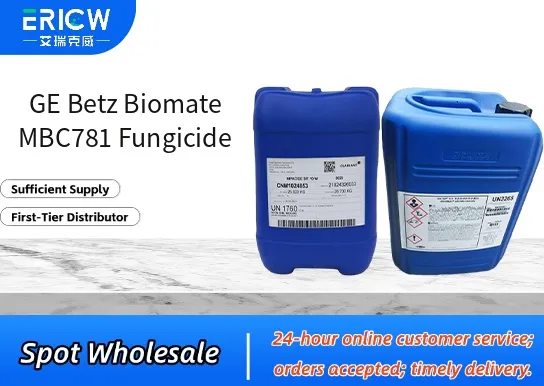
Effective broad-spectrum control against planktonic and sessile fungi, including Aspergillus, Cladosporium, and Penicillium species.
Non-oxidizing formulation minimizes corrosion risk to carbon steel, stainless steel, and copper alloys in recirculating water systems.
Compatible with common scale inhibitors, dispersants, and other biocides used in industrial water treatment programs.
Stable across a wide pH range (6.0–9.5) and effective at low dosages (50–200 ppm active ingredient).
Biodegradable under aerobic conditions, supporting sustainable water management practices.
Cooling water systems in power generation facilities.
Process water circuits in petrochemical and refinery operations.
Chilled water systems in commercial HVAC installations.
Make-up water treatment for closed-loop industrial cooling towers.
Pre-treatment of reclaimed water used in non-potable industrial applications.
| Chemical Type | Heterocyclic nitrogen-containing fungicide (active ingredient: 2-Methyl-4-isothiazolin-3-one derivative) |
| Product Form | Aqueous solution |
| Appearance | Clear, light amber liquid |
| pH (as supplied) | 3.0–5.0 |
| Density (20°C) | 1.02–1.05 g/cm³ |
| Solubility | Completely miscible with water |
| Primary Applications | Fungal control in industrial recirculating water systems |
| Storage Stability | ≥24 months in original sealed container at 5–30°C |
Q1: What is the primary mode of action of Biomate MBC781?
A: Biomate MBC781 functions as a broad-spectrum fungistatic agent, primarily inhibiting fungal cell wall synthesis and disrupting membrane integrity. Its active component targets key metabolic pathways in mold, yeast, and filamentous fungi commonly encountered in industrial water systems.
Q2: In which types of industrial systems is Biomate MBC781 typically applied?
A: It is specifically formulated for use in recirculating cooling water systems, closed-loop chilled water systems, and process water circuits where microbial fouling—especially biofilm-forming fungi and slime-forming organisms—poses operational or corrosion risks.
Q3: How does Biomate MBC781 compare to conventional oxidizing biocides in terms of stability and residual activity?
A: Unlike oxidizing biocides (e.g., chlorine or bromine), Biomate MBC781 is non-oxidizing and offers extended residual control in low-flow or stagnant zones. It maintains efficacy across a wide pH range and demonstrates good compatibility with common scale and corrosion inhibitors used in water treatment programs.
Q4: What safety and handling considerations apply during routine dosing?
A: As with all industrial biocides, appropriate personal protective equipment (PPE) — including chemical-resistant gloves and eye protection — should be worn during handling. Biomate MBC781 is supplied as a liquid concentrate and should be stored in a cool, dry, well-ventilated area away from strong oxidizers. Always consult the Safety Data Sheet (SDS) prior to use.
Q5: Can Biomate MBC781 be used in combination with other microbiocides?
A: Yes — it is frequently deployed in rotational or synergistic programs with oxidizing biocides or other non-oxidizing agents to mitigate resistance development and broaden spectrum coverage. Compatibility testing under site-specific conditions is recommended before full-scale implementation.
Contact With Us:
E-mail: wangxingqiang@ericwchem.com
Have a Questions? Call Us:
Add:
Building A1, Jiete Industrial Park, Huangpu District, Guangzhou City, Guangdong Province, China