English
 Español
 tiếng việt
 русский
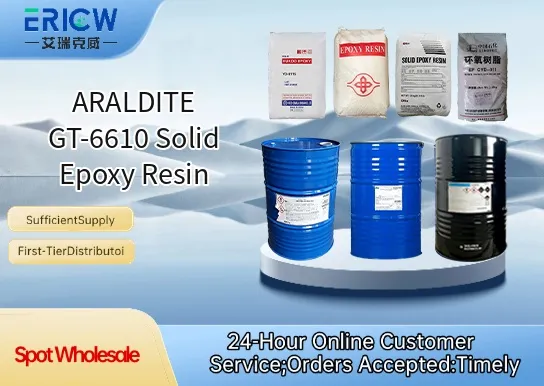
High-performance solid epoxy resin offering excellent thermal stability and chemical resistance.
Low volatile organic compound (VOC) content, supporting sustainable manufacturing processes.
Superior mechanical strength and dimensional stability after curing.
Excellent adhesion to metals, composites, and engineered plastics.
Designed for precise stoichiometric blending with standard amine or anhydride hardeners.
Aerospace composite matrix resins for structural laminates and prepregs.
High-reliability electrical encapsulation and potting in power electronics.
Advanced wind turbine blade bonding and structural adhesives.
Industrial tooling and mold-making where thermal and moisture resistance are critical.
Automotive under-hood components requiring long-term performance at elevated temperatures.
| Chemical Type | Bisphenol-F based solid epoxy resin |
| Product Form | Pale yellow to light amber solid flakes |
| Appearance | Free-flowing crystalline solid |
| Epoxy Equivalent Weight (EEW) | 175–185 g/eq |
| Melting Range | 65–75 °C |
| Softening Point (Ring & Ball) | 68–72 °C |
| Volatiles Content (105 °C, 2 h) | < 0.3 wt% |
| Key Features | High reactivity, low melt viscosity, excellent storage stability |
Q1: What is the primary function of ARALDITE GT-6610 in epoxy formulations?
A: ARALDITE GT-6610 is a solid bisphenol-A based epoxy resin designed primarily as a reactive binder and matrix former. It provides excellent adhesion, chemical resistance, and thermal stability when cured with appropriate hardeners, making it suitable for structural adhesives, high-performance composites, and electrical encapsulation systems.
Q2: How does GT-6610 differ from liquid epoxy resins in processing?
A: As a solid resin, GT-6610 offers improved handling safety, reduced volatility, and enhanced shelf-life stability compared to low-molecular-weight liquid epoxies. Its solid form facilitates precise metering in hot-melt or powder-based processes and supports solvent-free formulation strategies, particularly in industrial coating and prepreg applications.
Q3: Which types of hardeners are commonly used with GT-6610?
A: GT-6610 is compatible with a broad range of amine-based hardeners—including aromatic amines, dicyandiamide (DICY), and latent amine adducts—as well as anhydrides and phenolic resins. Selection depends on required cure profile, final performance targets (e.g., glass transition temperature, flexibility), and processing conditions such as ambient or elevated temperature curing.
Q4: Is GT-6610 suitable for food-contact or potable water applications?
A: GT-6610 is not pre-qualified for direct food-contact or drinking water applications. Its suitability for such uses depends entirely on the full cured system—including hardener, additives, and processing conditions—and must be validated through application-specific regulatory testing and compliance assessment by the end-user or qualified third party.
Contact With Us:
E-mail: wangxingqiang@ericwchem.com
Have a Questions? Call Us:
Add:
Building A1, Jiete Industrial Park, Huangpu District, Guangzhou City, Guangdong Province, China