English
 Español
 tiếng việt
 русский
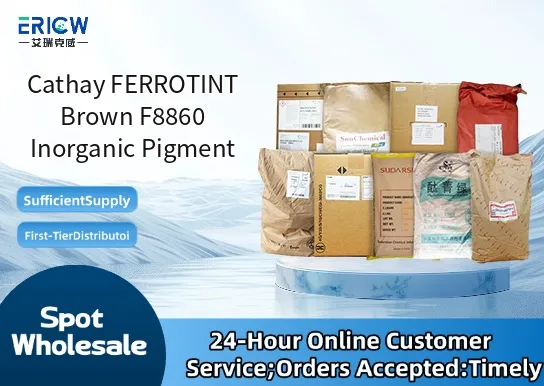
High thermal stability up to 800 °C, suitable for high-temperature ceramic and enamel applications.
Excellent lightfastness and weather resistance, ensuring long-term color retention under UV exposure.
Non-toxic and heavy-metal-free formulation compliant with global regulatory standards including EN 71-3 and RoHS.
Consistent particle size distribution for uniform dispersion and optimal opacity in demanding matrices.
Chemically inert in alkaline and mildly acidic environments, enhancing compatibility with cementitious and plaster systems.
Ceramic glazes and bodies for sanitaryware, tiles, and tableware.
Architectural coatings and facade renders requiring durable, fade-resistant brown tones.
Concrete and mortar colorants for precast elements and exposed aggregate finishes.
Plastics processing for outdoor applications including garden furniture and construction profiles.
Industrial powder coatings for metal substrates exposed to harsh environmental conditions.
| Chemical Type | Complex iron oxide-based inorganic pigment (Fe₂O₃–MnO–ZnO system) |
| Product Form | Free-flowing fine powder |
| Appearance | Uniform reddish-brown powder with matte finish |
| Primary Applications | Ceramics, architectural coatings, concrete, plastics, powder coatings |
| Key Features | Thermal stability, lightfastness, chemical inertness, low oil absorption |
| Benefits | Color consistency, batch-to-batch reproducibility, low dust generation during handling |
| pH (10% aqueous suspension) | 6.5–7.5 |
| Volatile Matter (105 °C, 2 h) | ≤ 0.5 wt% |
Q1: What is the primary chemical composition of Cathay FERROTINT Brown F8860?
A: Cathay FERROTINT Brown F8860 is an iron oxide-based inorganic pigment, primarily composed of complex mixed-phase iron oxides and hydroxides, engineered to deliver consistent warm brown coloration with high thermal and light stability.
Q2: Is this pigment suitable for use in polymer systems requiring high-temperature processing?
A: Yes — as a thermally stable inorganic pigment, F8860 is widely used in polyolefins, engineering plastics, and masterbatches processed at temperatures up to 300°C, without significant color shift or decomposition.
Q3: How does F8860 perform in outdoor applications exposed to UV radiation and weathering?
A: F8860 exhibits excellent UV resistance and weatherfastness due to its inorganic crystalline structure, making it well-suited for exterior coatings, architectural concrete, and plastic profiles where long-term color retention is critical.
Q4: Can F8860 be used in food-contact or pharmaceutical-grade formulations?
A: While F8860 is not pre-certified for direct food contact, it complies with general safety requirements for inorganic pigments in non-intent-to-contact applications. Regulatory compliance must be verified case-by-case based on final formulation, processing conditions, and applicable regional guidelines.
Q5: What is the typical dosage range when incorporating F8860 into coating or plastic systems?
A: Dosage depends on the desired opacity, color strength, and substrate; it is typically used at low concentrations, generally ranging from 0.1% to 2% by weight, with optimal dispersion achieved via standard high-shear mixing protocols.
Contact With Us:
E-mail: wangxingqiang@ericwchem.com
Have a Questions? Call Us:
Add:
Building A1, Jiete Industrial Park, Huangpu District, Guangzhou City, Guangdong Province, China