English
 Español
 tiếng việt
 русский
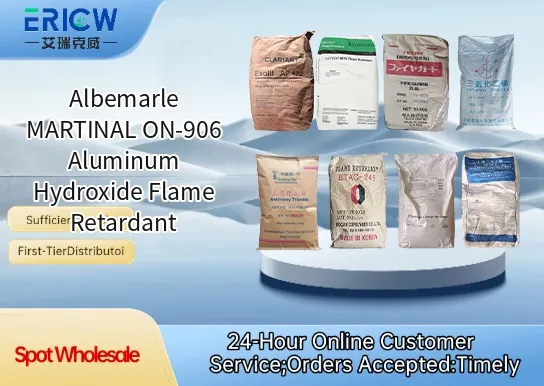
High-purity aluminum hydroxide with controlled particle size distribution for optimal dispersion in polymer matrices.
Endothermic decomposition at ~180–200 °C, releasing water vapor to cool the substrate and dilute flammable gases.
Halogen-free formulation, supporting compliance with RoHS, REACH, and low-smoke zero-halogen (LSZH) requirements.
Surface-treated with proprietary silane chemistry to enhance compatibility with polyolefins, PVC, and thermosets.
Low abrasivity and excellent thermal stability up to 250 °C during compounding and processing.
Flame-retarded wire & cable compounds (e.g., LSZH jacketing and insulation).
Fire-safe building materials including rigid PVC profiles, flooring, and ceiling panels.
Thermoplastic elastomers (TPEs) used in automotive interior components and consumer electronics housings.
Unsaturated polyester (UP) and vinyl ester composites for transportation and infrastructure applications.
| Chemical Type | Aluminum hydroxide, Al(OH)₃ |
| Product Form | Free-flowing white powder |
| Appearance | White, odorless, crystalline powder |
| Primary Applications | Wire & cable, construction polymers, automotive TPEs, composites |
| Key Features | Surface-modified, halogen-free, low-volatility, high thermal stability |
| Decomposition Onset Temperature | Approx. 180–200 °C (by TGA, 10 °C/min, air) |
| pH (10% aqueous slurry) | 7.5–8.5 |
| Moisture Content (max) | 0.5 wt% (as received) |
Q1: What is the primary mechanism of flame retardancy for MARTINAL ON-906?
A: MARTINAL ON-906 functions primarily through endothermic decomposition, releasing water vapor upon heating. This cools the substrate and dilutes flammable gases in the flame zone, while the resulting alumina residue forms a protective char layer that impedes heat and mass transfer.
Q2: How does ON-906 compare to other aluminum hydroxide grades in terms of processing performance?
A: ON-906 is engineered with controlled particle size distribution and surface treatment to enhance dispersion stability and reduce viscosity in polymer melts. It typically offers improved flow characteristics and lower torque during compounding compared to standard untreated aluminum hydroxide grades, especially in thermoplastics like polyolefins and engineering resins.
Q3: Is MARTINAL ON-906 suitable for halogen-free flame-retarded cable compounds?
A: Yes — ON-906 is widely used in halogen-free low-smoke zero-halogen (LSZH) cable jacketing and insulation formulations. Its high purity, consistent thermal stability profile, and compatibility with common cable polymers support compliance with fire safety requirements for reduced smoke density and acidity during combustion.
Q4: What are key handling considerations during storage and feeding?
A: Store in a cool, dry environment away from moisture and direct sunlight. Due to its hydrophilic nature, prolonged exposure to humid conditions may lead to agglomeration. For optimal feeding consistency, use volumetric or gravimetric dosing systems calibrated for fine, free-flowing mineral powders — avoid pneumatic conveying over long distances without validation.
Contact With Us:
E-mail: wangxingqiang@ericwchem.com
Have a Questions? Call Us:
Add:
Building A1, Jiete Industrial Park, Huangpu District, Guangzhou City, Guangdong Province, China