English
 Español
 tiếng việt
 русский
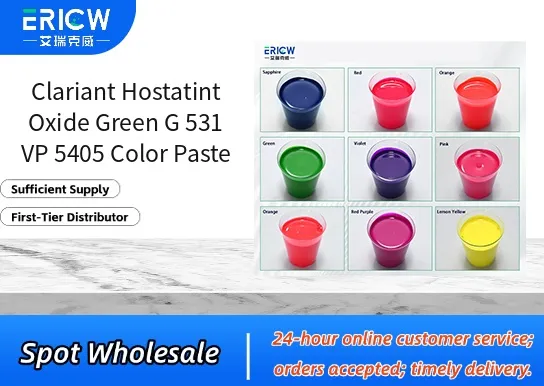
Highly concentrated iron oxide-based pigment dispersion offering excellent color strength and batch-to-batch consistency.
Optimized for water-based systems with good compatibility in acrylic, styrene-acrylic, and vinyl emulsion polymers.
Low volatile organic compound (VOC) content, supporting compliance with stringent environmental and regulatory requirements.
Excellent lightfastness and weather resistance, ensuring long-term color stability under outdoor exposure.
Shear-stable formulation minimizes viscosity drift during high-shear mixing and storage.
Architectural coatings including interior and exterior wall paints.
Industrial maintenance coatings for metal and concrete substrates.
Concrete and cementitious coloring for precast elements and paving slabs.
Water-based wood stains and clear finishes requiring durable green hue.
Plaster, stucco, and dry-mix mortar formulations.
| Chemical Type | Iron oxide green pigment dispersion |
| Product Form | Liquid color paste |
| Appearance | Viscous, homogeneous green paste |
| Primary Applications | Water-based architectural and industrial coatings; cementitious materials |
| Key Features | High opacity, low VOC, shear-stable, alkali-resistant |
| Benefits | Reduced dosing, improved color uniformity, simplified formulation |
| Storage Stability | 12 months at 5–30 °C in sealed original container |
| Compatible Media | Acrylic, styrene-acrylic, vinyl acetate, and PVA-based systems |
Q1: What is the primary application field for Hostatint Oxide Green G 531 VP 5405?
A: This pigment paste is primarily formulated for coloring polyolefin compounds—especially PP and HDPE—in applications requiring high thermal stability, good dispersion, and resistance to blooming during processing and end-use.
Q2: Is this color paste suitable for food-contact plastics?
A: Hostatint Oxide Green G 531 VP 5405 is designed for use in food-contact compliant formulations when incorporated into approved polymer systems and processed under validated conditions; final regulatory compliance depends on the full formulation, processing parameters, and applicable regional regulations.
Q3: How should this paste be dispersed in polyolefin melts?
A: Optimal dispersion is achieved using standard compounding equipment such as twin-screw extruders; pre-mixing with a portion of the base resin prior to extrusion enhances homogeneity and minimizes agglomeration.
Q4: What is the typical dosage range for achieving medium to deep green shades?
A: Dosage varies depending on the desired shade intensity and base polymer opacity, but it is typically used at low concentrations—generally ranging from 0.1% to 2% by weight relative to the total compound.
Contact With Us:
E-mail: wangxingqiang@ericwchem.com
Have a Questions? Call Us:
Add:
Building A1, Jiete Industrial Park, Huangpu District, Guangzhou City, Guangdong Province, China