English
 Español
 tiếng việt
 русский
High-gloss finish with excellent clarity and color retention.
Superior weather resistance for extended outdoor durability.
Good compatibility with common solvents, pigments, and co-resins.
Optimized drying profile—balanced through-dry and surface-dry performance.
Low volatile organic compound (VOC) formulation compliant with modern environmental regulations.
Architectural solvent-based topcoats for exterior wood and metal substrates.
Industrial maintenance coatings for bridges, pipelines, and structural steel.
General-purpose enamel paints requiring gloss, hardness, and flexibility.
Marine and offshore protective coatings where UV stability is critical.
Automotive refinish primers and basecoats in OEM-adjacent repair systems.
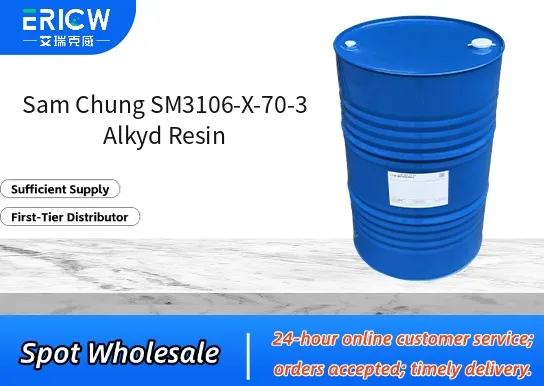
| Chemical Type | Long-oil modified alkyd resin (soybean oil-based) |
| Product Form | Liquid solution in aromatic hydrocarbon solvent |
| Appearance | Clear, amber to light brown viscous liquid |
| Non-Volatile Content (wt%) | ~70 ± 1% |
| Viscosity (25°C, Brookfield RVT, #4 spindle, 20 rpm) | 8,000–12,000 cP |
| Acid Value (mg KOH/g) | 6–9 |
| Density (25°C) | 0.96–0.99 g/cm³ |
| Flash Point (Cleveland Open Cup) | ≥ 75°C |
Q1: What is the primary application of SM3106-X-70-3 in coating systems?
A: SM3106-X-70-3 is a medium-oil alkyd resin designed for solvent-based decorative and protective coatings, particularly where balanced drying speed, gloss retention, and flexibility are required — commonly used in industrial maintenance paints, wood finishes, and general-purpose enamels.
Q2: Is SM3106-X-70-3 compatible with common crosslinkers like melamine-formaldehyde or polyisocyanates?
A: Yes — it exhibits good compatibility with amino resins (e.g., melamine-formaldehyde) for baked systems and can be formulated with blocked isocyanates for ambient- or forced-dry two-component applications, depending on catalyst selection and processing conditions.
Q3: How should SM3106-X-70-3 be stored to maintain stability and performance?
A: Store in tightly sealed containers in a cool, dry, well-ventilated area away from direct sunlight and sources of heat or ignition. Under these conditions, shelf life is typically 12 months from date of manufacture; avoid prolonged exposure to moisture or freezing temperatures.
Q4: Can SM3106-X-70-3 be modified or blended with other resins to adjust film properties?
A: Yes — it is frequently blended with acrylics, vinyls, or phenolics to tailor hardness, chemical resistance, or weathering performance. Modification via fatty acid exchange or post-addition of reactive diluents is also practiced, though compatibility testing is recommended for each formulation.
Contact With Us:
E-mail: wangxingqiang@ericwchem.com
Have a Questions? Call Us:
Add:
Building A1, Jiete Industrial Park, Huangpu District, Guangzhou City, Guangdong Province, China