English
 Español
 tiếng việt
 русский
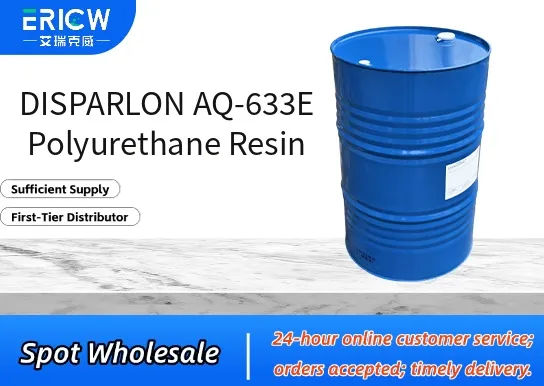
Waterborne anionic polyurethane dispersion with excellent film-forming capability.
Outstanding flexibility and abrasion resistance for demanding coating applications.
Good compatibility with acrylics, cellulose derivatives, and common crosslinkers.
Low VOC content, compliant with stringent environmental and safety regulations.
Stable storage performance at 5–40 °C without sedimentation or viscosity drift.
Leather finishing topcoats for footwear and upholstery.
Flexible packaging coatings requiring high gloss and rub resistance.
Textile coatings for stretch fabrics and technical apparel.
Wood coatings where elasticity and substrate adhesion are critical.
Industrial protective coatings for plastic and composite substrates.
| Chemical Type | Anionic aliphatic polyurethane dispersion |
| Product Form | Aqueous dispersion |
| Appearance | Opaque white to light yellow liquid |
| pH (at 25 °C) | 7.5–8.5 |
| Solids Content (wt%) | 30.0 ± 1.0 |
| Viscosity (mPa·s, Brookfield LVT, #2 spindle, 20 rpm) | 150–400 |
| Density (g/cm³, 25 °C) | 1.01–1.03 |
| Minimum Film Formation Temperature (MFFT) | 15–20 °C |
Q1: What is the primary function of DISPARLON AQ-633E in waterborne coating systems?
A: DISPARLON AQ-633E is a polyurethane-based dispersing resin designed to stabilize pigment particles in aqueous media, improving dispersion efficiency, storage stability, and color development—particularly for challenging organic pigments and effect pigments in low-VOC coatings.
Q2: Is DISPARLON AQ-633E compatible with other common waterborne resins and additives?
A: Yes, it demonstrates good compatibility with acrylic emulsions, vinyl acetate copolymers, and many waterborne polyurethane dispersions. It is also generally stable in the presence of common co-solvents, defoamers, and rheology modifiers—though compatibility testing under final formulation conditions is recommended.
Q3: How should DISPARLON AQ-633E be incorporated into a pigment grinding process?
A: It is typically added during the pre-mix stage, before high-shear dispersion begins. For optimal performance, it is recommended to premix the resin with water or co-solvent and then add the pigment gradually while stirring, followed by standard dispersion protocols using bead mills or high-speed dispersers.
Q4: Does DISPARLON AQ-633E contribute to film properties in the final coating?
A: While primarily used as a processing aid, its polyurethane backbone can impart mild improvements in scrub resistance and binder integrity in the dried film—especially when used at higher dosage levels—but it is not intended as a primary film-former or crosslinker.
Contact With Us:
E-mail: wangxingqiang@ericwchem.com
Have a Questions? Call Us:
Add:
Building A1, Jiete Industrial Park, Huangpu District, Guangzhou City, Guangdong Province, China