English
 Español
 tiếng việt
 русский
High reactivity with amine and anhydride hardeners for rapid gelation and short cure cycles.
Excellent adhesion to metals, composites, and cured epoxy substrates.
Low viscosity (12,000–14,000 cP at 25°C) enabling easy processing and good wetting of reinforcements.
Superior thermal stability with glass transition temperature (Tg) up to 125°C after full cure.
Low chloride content (< 800 ppm), ensuring compatibility with sensitive electronic encapsulation applications.
Structural adhesives for aerospace and automotive bonding.
Prepreg matrix resin for carbon fiber reinforced composites.
Encapsulation and potting compounds for power electronics and LED modules.
High-performance coatings for corrosion protection on steel and aluminum substrates.
Electrical laminates in printed circuit board (PCB) base materials.
| Chemical Type | Diglycidyl ether of bisphenol-A (DGEBA) |
| Product Form | Liquid resin |
| Appearance | Pale yellow transparent liquid |
| Epoxy Equivalent Weight (EEW) | 186–192 g/eq |
| Viscosity (25°C) | 12,000–14,000 cP |
| Softening Point | Not applicable (liquid at room temperature) |
| Chloride Content | < 800 ppm |
| Volatiles Content | < 0.3 wt% |
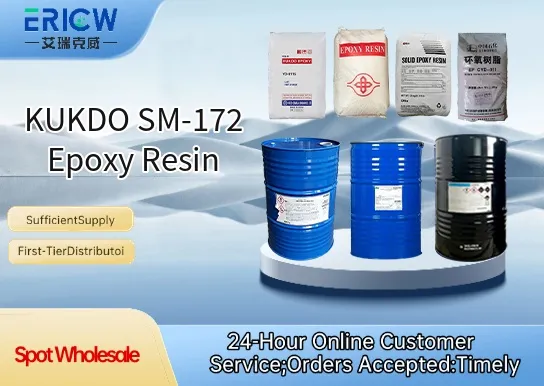
Q1: What is the primary functional role of KUKDO SM-172 in epoxy formulations?
A: KUKDO SM-172 functions as a reactive diluent and viscosity modifier, enabling improved processability while maintaining crosslink density and thermal stability in cured epoxy systems.
Q2: Is KUKDO SM-172 compatible with standard amine and anhydride hardeners?
A: Yes, SM-172 demonstrates broad compatibility with common aliphatic, cycloaliphatic, and aromatic amine hardeners, as well as anhydride curing agents, without significant induction time delay or phase separation under typical processing conditions.
Q3: How does SM-172 affect the glass transition temperature (Tg) of cured epoxy networks?
A: When incorporated at typical usage levels, SM-172 generally results in a modest reduction in Tg compared to unmodified resin systems—this effect is formulation-dependent and can be balanced through hardener selection and stoichiometric adjustment.
Q4: Can SM-172 be used in applications requiring low volatile organic compound (VOC) content?
A: Yes—SM-172 is a low-volatility, non-reactive-diluent-free epoxy reactive diluent, contributing to reduced VOC emissions during processing and supporting compliance with industrial low-VOC formulation goals.
Q5: What storage conditions are recommended for optimal shelf life?
A: Store in tightly sealed original containers at temperatures between 10–25 °C, away from direct sunlight and moisture. Under these conditions, SM-172 maintains consistent reactivity and clarity for at least 12 months from date of manufacture.
Contact With Us:
E-mail: wangxingqiang@ericwchem.com
Have a Questions? Call Us:
Add:
Building A1, Jiete Industrial Park, Huangpu District, Guangzhou City, Guangdong Province, China