English
 Español
 tiếng việt
 русский
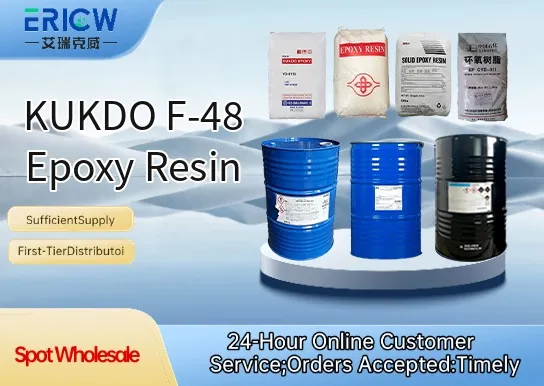
High-purity bisphenol-F based epoxy resin with low chloride content for enhanced electrical insulation.
Excellent thermal stability and glass transition temperature (Tg) suitable for demanding curing profiles.
Low viscosity at elevated temperatures, enabling superior processability in casting, impregnation, and laminating.
Outstanding chemical resistance to alkalis, solvents, and weak acids after full cure.
Consistent molecular weight distribution ensures reproducible reactivity and mechanical performance.
Electrical insulation systems for high-voltage transformers and bushings.
Casting resins for encapsulation of power electronics and LED modules.
Matrix resin in high-performance fiber-reinforced composites for aerospace tooling.
Structural adhesives requiring elevated temperature resistance and dimensional stability.
Prepregs and laminates for printed circuit board (PCB) substrates demanding low ionic contamination.
| Chemical Type | Bisphenol-F epoxy resin |
| Product Form | Off-white to light yellow solid flakes or pellets |
| Appearance | Homogeneous, free-flowing solid at room temperature |
| Epoxy Equivalent Weight (EEW) | 165–175 g/eq |
| Melting Point | 48–52 °C |
| Softening Point | 50–54 °C (ASTM D36) |
| Chloride Content | ≤ 500 ppm |
| Volatiles (150 °C, 2 h) | ≤ 0.3 wt% |
Q1: What is the primary function of KUKDO F-48 in epoxy formulations?
A: KUKDO F-48 is a reactive diluent designed to reduce viscosity and improve processability of standard bisphenol-A or bisphenol-F based epoxy resins without significantly compromising final crosslink density or thermal performance.
Q2: Is KUKDO F-48 suitable for high-gloss coating applications?
A: Yes — due to its low volatility, good compatibility, and ability to support high crosslink uniformity, KUKDO F-48 is commonly used in premium decorative and protective coatings where surface clarity, hardness, and chemical resistance are critical.
Q3: How does KUKDO F-48 compare to non-reactive diluents in terms of VOC content and film properties?
A: As a reactive diluent, KUKDO F-48 becomes chemically bound into the polymer network during cure, resulting in negligible VOC contribution and superior long-term durability compared to solvent- or non-reactive plasticizer-based systems.
Q4: Can KUKDO F-48 be used in adhesives requiring flexibility and impact resistance?
A: Yes — when incorporated at appropriate levels, it helps moderate rigidity while maintaining cohesive strength, making it suitable for structural and semi-structural adhesive formulations where balanced toughness and adhesion are required.
Contact With Us:
E-mail: wangxingqiang@ericwchem.com
Have a Questions? Call Us:
Add:
Building A1, Jiete Industrial Park, Huangpu District, Guangzhou City, Guangdong Province, China