English
 Español
 tiếng việt
 русский
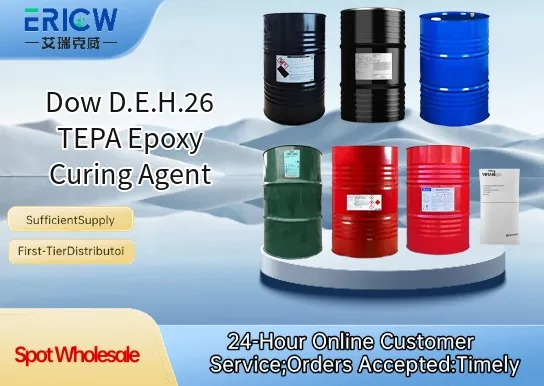
Highly reactive tetraethylenepentamine (TEPA)-based aliphatic amine curing agent for rapid epoxy resin crosslinking.
Delivers excellent adhesion to metals, concrete, and composite substrates without surface priming.
Provides good flexibility and impact resistance in cured epoxy systems at ambient and elevated temperatures.
Low viscosity enables easy handling, metering, and thorough mixing with standard epoxy resins.
Compatible with bisphenol-A and bisphenol-F epoxy resins for structural and protective coating formulations.
Industrial maintenance coatings for steel structures, pipelines, and offshore platforms.
Electrical encapsulation and potting compounds for transformers and high-voltage components.
Adhesives and structural bonding agents in transportation and wind energy composites.
Flooring systems requiring rapid turnaround and chemical resistance in manufacturing facilities.
Repair mortars and grouts for concrete infrastructure rehabilitation.
| Chemical Type | Tetraethylenepentamine (TEPA)-derived aliphatic polyamine |
| Product Form | Liquid |
| Appearance | Clear to pale yellow liquid |
| Primary Applications | Epoxy coatings, adhesives, encapsulants, and repair mortars |
| Key Features | Ambient-cure capability, low viscosity, high reactivity, strong substrate adhesion |
| Benefits | Reduced processing time, improved toughness, enhanced corrosion protection |
| Storage Conditions | Store in original sealed container at 15–25°C; protect from moisture and freezing |
| Handling Precautions | Use appropriate PPE (gloves, goggles, ventilation); avoid skin/eye contact |
Q1: What is the primary chemical nature of D.E.H.26 TEPA?
A: D.E.H.26 TEPA is a tetraethylenepentamine (TEPA)-based aliphatic polyamine curing agent, formulated to provide efficient reactivity with epoxy resins while supporting good pot life and mechanical performance in cured systems.
Q2: How does D.E.H.26 differ from standard TEPA in epoxy formulations?
A: D.E.H.26 is a modified TEPA derivative designed to reduce volatility and skin sensitization potential compared to unmodified TEPA, while maintaining strong curing activity and enabling improved handling safety and regulatory compliance in industrial applications.
Q3: What types of epoxy resins is D.E.H.26 typically compatible with?
A: D.E.H.26 is broadly compatible with standard liquid and solid bisphenol-A and bisphenol-F epoxy resins, as well as many novolac and cycloaliphatic epoxies—particularly where enhanced flexibility, adhesion, or low-temperature cure performance is desired.
Q4: What are typical handling and storage recommendations for this curing agent?
A: Store in tightly sealed containers under dry, cool conditions away from moisture, strong oxidizers, and direct sunlight. Due to its amine functionality, it is hygroscopic and may absorb CO₂ from air over time—therefore, minimize exposure during handling and consider inert gas blanketing for extended storage.
Q5: Is D.E.H.26 suitable for applications requiring FDA-compliant food-contact coatings?
A: D.E.H.26 is not pre-approved for direct food-contact use under FDA regulations. Formulators must conduct full system-level testing and validation—including extraction studies and regulatory review—to determine suitability for specific food-contact applications.
Contact With Us:
E-mail: wangxingqiang@ericwchem.com
Have a Questions? Call Us:
Add:
Building A1, Jiete Industrial Park, Huangpu District, Guangzhou City, Guangdong Province, China