English
 Español
 tiếng việt
 русский
Excellent low-temperature flexibility and impact resistance down to –50 °C
High melt flow rate (MFR) enabling efficient processing in injection molding and extrusion
Outstanding compatibility with polypropylene (PP) and polyethylene (PE) for blend modification
Good clarity and gloss, suitable for transparent or semi-transparent end products
Low extractables and excellent color stability for demanding applications
Automotive interior parts (e.g., instrument panels, door trims, soft-touch surfaces)
Packaging films requiring toughness, sealability, and clarity
Flexible consumer goods (e.g., grips, seals, squeezable bottles)
Medical device components requiring biocompatibility support and sterilization resistance
Thermoplastic elastomer (TPE) formulations for overmolding and co-extrusion
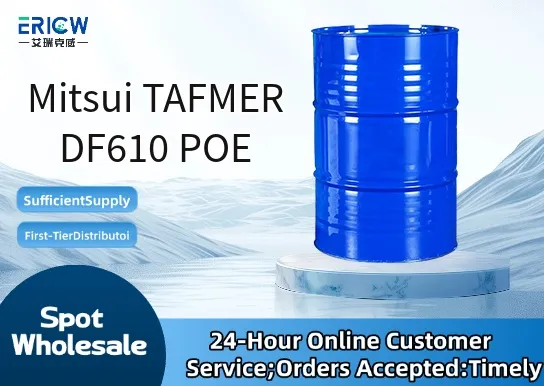
| Chemical Type | Ethylene–octene copolymer (POE) |
| Product Form | Pellets |
| Appearance | Off-white, free-flowing cylindrical pellets |
| Melt Flow Rate (MFR), 190 °C/2.16 kg | 6.0 g/10 min (typical) |
| Density | 0.870 g/cm³ (typical) |
| Octene Content | ~20 wt% (approx.) |
| Key Features | High elasticity, PP/PE compatibility, low-temperature performance |
| Primary Applications | Soft-touch overmolding, flexible packaging, automotive thermoplastics |
Q1: What is the primary function of TAFMER DF610 in polymer blends?
A: TAFMER DF610 is an ethylene–octene copolymer designed primarily as a compatibilizer and impact modifier, especially for polyolefin-based systems such as PP/PE blends or filled composites. It enhances interfacial adhesion, improves toughness at low temperatures, and supports better dispersion of fillers or other polymers.
Q2: Is TAFMER DF610 suitable for food-contact applications?
A: TAFMER DF610 is not pre-approved for direct food contact under major global regulatory frameworks. Its suitability depends on final formulation, processing conditions, and end-use compliance requirements. Customers must conduct full regulatory evaluation—including migration testing and regulatory dossier review—prior to use in food-contact applications.
Q3: How does TAFMER DF610 compare to conventional EPDM or EPR impact modifiers in PP systems?
A: Unlike traditional EPDM or EPR elastomers, TAFMER DF610 offers narrower molecular weight distribution and more uniform comonomer incorporation, resulting in improved processability, finer phase morphology, and enhanced balance between stiffness and impact performance in PP compounds. It also typically requires lower dosage to achieve comparable toughening effects.
Q4: What are recommended processing methods for TAFMER DF610?
A: TAFMER DF610 is compatible with standard thermoplastic processing techniques including twin-screw extrusion, injection molding, and compounding. It exhibits good thermal stability up to typical polyolefin processing temperatures and demonstrates low melt viscosity, facilitating efficient mixing and dispersion in masterbatch or final blend preparation.
Contact With Us:
E-mail: wangxingqiang@ericwchem.com
Have a Questions? Call Us:
Add:
Building A1, Jiete Industrial Park, Huangpu District, Guangzhou City, Guangdong Province, China