English
 Español
 tiếng việt
 русский
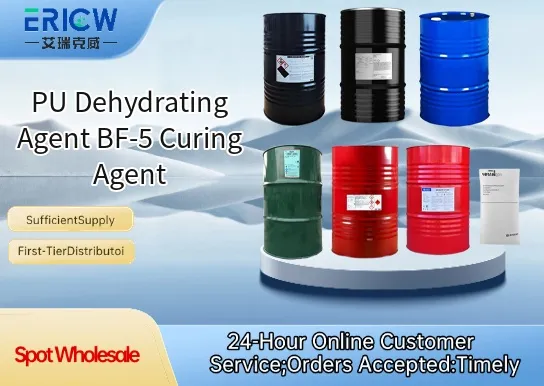
Highly effective moisture scavenger specifically formulated for polyurethane systems.
Enables rapid and complete removal of trace water from polyol blends and isocyanate prepolymers.
Non-reactive with isocyanates under normal processing conditions—preserves stoichiometry and pot life.
Improves foam dimensional stability and reduces surface defects caused by water-induced CO₂ formation.
Compatible with aromatic and aliphatic isocyanates, as well as polyester and polyether polyols.
Rigid and flexible polyurethane foam production for insulation and seating applications.
Cast elastomer and reaction injection molding (RIM) systems requiring low-moisture environments.
Two-component polyurethane adhesives and sealants where bubble-free cure is critical.
Coating formulations for automotive and industrial finishes demanding high film integrity.
Moisture-sensitive polyurethane prepolymers used in specialty elastomers and gels.
| Chemical Type | Organometallic dehydrating agent (non-hydrolyzable) |
| Product Form | Clear to pale yellow liquid |
| Appearance | Homogeneous, free of suspended particles or sediment |
| Primary Applications | PU foam, elastomers, adhesives, coatings, and sealants |
| Key Features | Water-selective reactivity, thermal stability up to 120°C |
| Benefits | Eliminates pinholes, improves cell structure, extends shelf life of moisture-sensitive components |
| Storage Conditions | Store in original sealed container at 5–30°C, protect from moisture and direct sunlight |
| Packaging | 25 kg HDPE drums or 200 kg steel drums |
Q1: What is the primary function of BF-5 in polyurethane systems?
A: BF-5 acts as a moisture scavenger and auxiliary curing agent, effectively removing trace water from PU formulations to prevent CO₂ gas formation, foam instability, and surface defects—especially critical in moisture-sensitive applications like coatings, adhesives, and encapsulants.
Q2: How does BF-5 differ from conventional isocyanate-based curing agents?
A: Unlike stoichiometric crosslinkers, BF-5 is not a primary curing agent but a reactive dehydrating additive. It consumes water before it reacts with isocyanates, thereby preserving NCO functionality, extending pot life, and improving final film integrity without significantly altering the base cure chemistry.
Q3: Is BF-5 compatible with aromatic and aliphatic polyisocyanate systems?
A: Yes, BF-5 demonstrates broad compatibility with both aromatic (e.g., TDI, MDI) and aliphatic (e.g., HDI, IPDI) isocyanates, as well as common polyol blends—including polyester, polyether, and acrylic types—making it suitable for diverse PU formulations across industrial segments.
Q4: What is the recommended handling and storage guidance for BF-5?
A: BF-5 should be stored in tightly sealed containers under dry, cool conditions (below 30 °C), protected from ambient moisture and humidity. Due to its reactivity with water, avoid prolonged exposure to air during dispensing, and use desiccant-equipped transfer systems where high formulation consistency is required.
Contact With Us:
E-mail: wangxingqiang@ericwchem.com
Have a Questions? Call Us:
Add:
Building A1, Jiete Industrial Park, Huangpu District, Guangzhou City, Guangdong Province, China