English
 Español
 tiếng việt
 русский
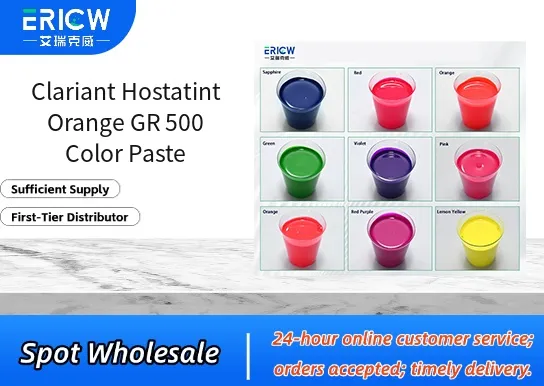
High chroma, lightfast orange shade based on high-performance organic pigment.
Excellent dispersion stability in water-based and solvent-based systems.
Low volatile organic compound (VOC) content, supporting sustainable formulation goals.
Good heat stability up to 180 °C, suitable for demanding processing conditions.
Optimized rheology for easy handling, pumping, and metering in industrial coloration processes.
Water-based architectural coatings and decorative paints.
Industrial maintenance coatings for metal and concrete substrates.
Plastic coloration of polyolefins and PVC compounds.
Printing inks for packaging and label applications.
Wood stains and transparent wood finishes requiring vivid orange tones.
| Chemical Type | Organic pigment dispersion (azo-type) |
| Product Form | Concentrated liquid color paste |
| Appearance | Homogeneous orange paste, free of grit or sediment |
| Primary Applications | Coatings, plastics, inks, wood stains |
| Key Features | High tinctorial strength, excellent lightfastness (ISO 105-B02: ≥6), good weather resistance |
| Benefits | Reduced dosing requirement, consistent batch-to-batch color match, low migration tendency |
| Recommended Storage | 15–25 °C, protected from freezing and direct sunlight |
| Shelf Life | 24 months from date of manufacture under recommended storage |
Q1: What types of polymers is Hostatint Orange GR 500 Color Paste compatible with?
A: Hostatint Orange GR 500 is formulated for use in a broad range of thermoplastics, including polyolefins (PP, PE), styrenics (PS, ABS), and engineering plastics such as PA and PET. Compatibility should always be confirmed through application-specific testing due to formulation variability.
Q2: Is this color paste suitable for applications requiring food contact compliance?
A: Hostatint Orange GR 500 is designed for non-food-contact applications. It is not intended for direct or indirect food contact use, and no food contact regulatory clearances are claimed for this grade.
Q3: How should the color paste be incorporated into polymer melts?
A: The paste is typically introduced via gravimetric or volumetric dosing directly into the extruder feed throat or injection molding hopper. Pre-blending with base resin is recommended for optimal dispersion, especially at lower dosage levels.
Q4: What is the typical dosage range for achieving standard orange shades?
A: Dosage depends on the target shade intensity and polymer matrix, but it is generally used at low concentrations—typically ranging from 0.1% to 2% by weight relative to the base polymer.
Contact With Us:
E-mail: wangxingqiang@ericwchem.com
Have a Questions? Call Us:
Add:
Building A1, Jiete Industrial Park, Huangpu District, Guangzhou City, Guangdong Province, China