English
 Español
 tiếng việt
 русский
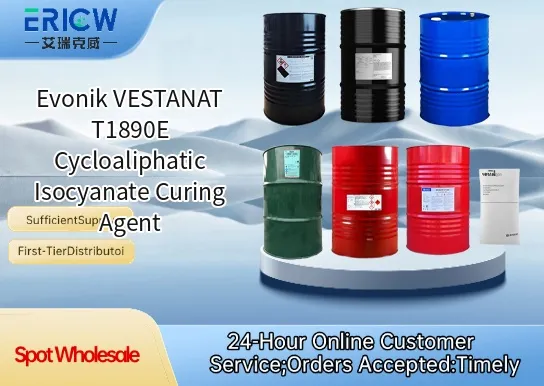
Highly reactive cycloaliphatic isocyanate with excellent weather resistance and UV stability.
Low viscosity enables easy handling, precise metering, and improved formulation flexibility.
Non-yellowing performance ideal for high-gloss and transparent coating systems.
Enhanced chemical resistance and mechanical durability in cured polyurethane coatings.
Compatible with a broad range of polyols including polyester, acrylic, and polycarbonate diols.
High-performance industrial maintenance coatings for infrastructure and machinery.
Automotive clearcoats and OEM topcoats requiring long-term gloss retention.
Aerospace exterior coatings demanding superior UV resistance and thermal stability.
Architectural façade and facade coatings exposed to harsh environmental conditions.
Precision optical and electronic encapsulation systems requiring clarity and stability.
| Chemical Type | Cycloaliphatic diisocyanate (hexahydro-4-methylphthalic acid diisocyanate derivative) |
| Product Form | Liquid |
| Appearance | Colorless to pale yellow, clear liquid |
| NCO Content (wt %) | Approx. 17.5–18.5% |
| Viscosity (25 °C, mPa·s) | 300–600 |
| Density (20 °C, g/cm³) | 1.12–1.16 |
| Storage Stability | Stable under dry, cool, and dark conditions; protect from moisture |
| Primary Applications | Two-component polyurethane coatings, clearcoats, and high-durability protective systems |
Q1: What is the primary functional advantage of VESTANAT T1890E compared to aromatic isocyanate curing agents?
A: VESTANAT T1890E offers superior UV stability and long-term color retention due to its cycloaliphatic structure, making it ideal for high-performance coatings where yellowing resistance and gloss retention are critical—unlike aromatic isocyanates, which are prone to photo-oxidative degradation.
Q2: How does VESTANAT T1890E perform in moisture-sensitive applications?
A: As a low-viscosity, monomeric cycloaliphatic isocyanate with sterically hindered NCO groups, T1890E exhibits reduced reactivity toward ambient moisture compared to conventional aliphatic isocyanates—enabling improved pot life and handling stability in humid environments without requiring stringent drying of substrates or ambient air.
Q3: Is VESTANAT T1890E compatible with standard hydroxyl-functional resins used in industrial coatings?
A: Yes—it is broadly compatible with common polyol systems including polyester, acrylic, and polyether polyols, and delivers excellent crosslink density and film hardness when formulated with typical OH-functional binders in two-component polyurethane systems.
Q4: What are the recommended storage conditions to maintain product integrity?
A: Store in tightly sealed original containers under dry, cool conditions (below 30 °C), protected from moisture, heat, and direct sunlight. Prolonged exposure to humidity or elevated temperatures may lead to dimerization or gelation over time.
Contact With Us:
E-mail: wangxingqiang@ericwchem.com
Have a Questions? Call Us:
Add:
Building A1, Jiete Industrial Park, Huangpu District, Guangzhou City, Guangdong Province, China