English
 Español
 tiếng việt
 русский
Broad-spectrum preventive and curative activity against key fungal pathogens including Botrytis, Sclerotinia, and Monilinia species.
Optimized systemic mobility within plant tissues for reliable protection of new growth and fruiting structures.
Low mammalian toxicity profile with favorable environmental safety characteristics for integrated pest management (IPM) programs.
Compatible with most commonly used insecticides, growth regulators, and foliar nutrients in tank-mix applications.
Stable formulation ensures consistent performance under varying pH and water hardness conditions.
Fruit orchards — especially stone fruits (peaches, plums, cherries) and pome fruits (apples, pears).
Vineyards for control of Botrytis cinerea (gray mold) and bunch rot during flowering and veraison stages.
Protected horticulture — greenhouse tomatoes, cucumbers, and strawberries.
Soft fruit production — raspberries, blackberries, and blueberries.
| Chemical Type | Triazole fungicide (active ingredient: difenoconazole) |
| Product Form | Emulsifiable concentrate (EC) |
| Appearance | Amber to light brown clear liquid |
| Active Ingredient Concentration | 210 g/L difenoconazole |
| pH Range (1% aqueous solution) | 5.5 – 7.5 |
| Density (20°C) | 1.02 – 1.06 g/cm³ |
| Solubility in Water | Low (3.4 mg/L at 20°C); forms stable emulsion upon dilution |
| Primary Applications | Foliar spray for high-value horticultural crops |
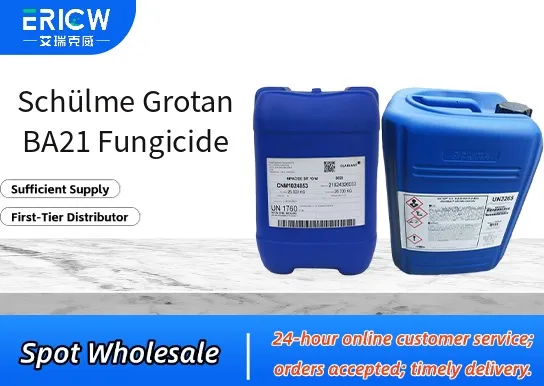
Q1: What types of formulations is Grotan BA21 typically used in?
A: Grotan BA21 is primarily employed in water-based industrial coatings, adhesives, sealants, and construction materials where long-term protection against mold, mildew, and fungal degradation is required. It is especially suited for systems with neutral to slightly alkaline pH.
Q2: How does Grotan BA21 differ from other isothiazolinone-based fungicides?
A: Grotan BA21 features a stabilized blend designed to offer enhanced compatibility with common formulation components and improved hydrolytic stability compared to conventional isothiazolinones—particularly under storage conditions typical for industrial applications.
Q3: Is Grotan BA21 suitable for use in products intended for indoor environments?
A: Yes, when used at recommended dosage levels, Grotan BA21 supports low-VOC, low-odor formulations commonly specified for interior architectural coatings and building materials—provided final product compliance with applicable regional regulatory requirements is verified by the formulator.
Q4: What is the typical dosage range for effective fungal control?
A: Effective dosage generally ranges from 0.1% to 2% by weight of active ingredient, depending on the specific formulation matrix, anticipated microbial challenge, and required duration of protection. Optimization through laboratory challenge testing is strongly recommended.
Q5: Does Grotan BA21 require pH adjustment during incorporation?
A: While Grotan BA21 performs best within a pH range of approximately 6–9, it does not typically require aggressive pH adjustment in most stable aqueous systems. However, maintaining formulation pH within this window is advised to ensure optimal performance and shelf-life stability.
Contact With Us:
E-mail: wangxingqiang@ericwchem.com
Have a Questions? Call Us:
Add:
Building A1, Jiete Industrial Park, Huangpu District, Guangzhou City, Guangdong Province, China