English
 Español
 tiếng việt
 русский
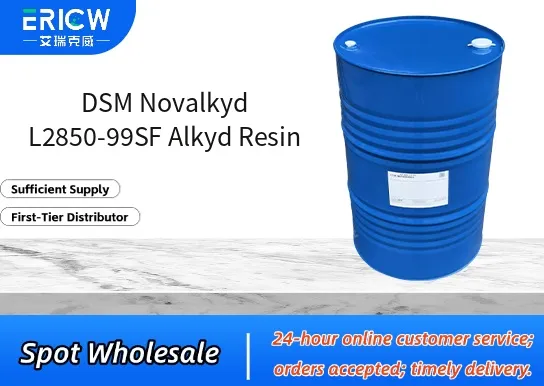
High-solids, low-VOC alkyd resin compliant with stringent global environmental regulations.
Excellent through-dry and hardness development for fast production line throughput.
Superior gloss retention and weather resistance in exterior architectural and industrial coatings.
Good compatibility with common co-resins (e.g., styrenated alkyds, acrylics) and pigment systems.
Optimized rheology for brush/roller application with minimal sag and excellent leveling.
High-performance exterior wood stains and clear finishes.
Premium decorative architectural paints for façades and trim.
Industrial maintenance coatings for metal substrates in mild-to-moderate exposure environments.
Marine topcoats for non-immersion above-waterline applications.
General-purpose protective coatings for agricultural and construction equipment.
| Chemical Type | Long-oil modified alkyd resin (soya oil-based) |
| Product Form | Liquid, solvent-borne |
| Appearance | Clear to pale yellow viscous liquid |
| Primary Applications | Exterior architectural coatings, industrial maintenance paints, wood finishes |
| Key Features | Low VOC, high solids (~65–70% w/w), fast dry, good UV stability |
| Recommended Solvent | Aromatic hydrocarbons (e.g., xylene, high-flash naphtha) |
| Storage Stability | Stable for ≥12 months at 10–30°C in sealed containers |
| Handling Precautions | Refer to Safety Data Sheet (SDS); avoid prolonged skin contact and inhalation of vapors |
Q1: What is the primary application of Novalkyd L2850-99SF in industrial coatings?
A: Novalkyd L2850-99SF is a solvent-borne, short-oil alkyd resin specifically designed for high-performance air-drying industrial maintenance and protective coatings, where excellent gloss retention, hardness development, and substrate adhesion are required.
Q2: Is this resin suitable for use in low-VOC formulations?
A: While L2850-99SF is solvent-borne and not inherently low-VOC, it can be incorporated into VOC-compliant systems when blended with reactive diluents or combined with high-solids alkyd-modified architectures—formulation strategy and solvent selection are key to meeting regional VOC targets.
Q3: How does L2850-99SF differ from conventional long-oil alkyds?
A: As a short-oil alkyd, L2850-99SF offers faster through-dry, higher crosslink density, and improved chemical resistance compared to long-oil variants—making it better suited for durable topcoats rather than flexible primers or rust-inhibitive undercoats.
Q4: Can L2850-99SF be modified or co-reacted with other resins?
A: Yes—it is commonly modified with melamine formaldehyde resins to enhance cure speed and thermal stability, or blended with acrylics and polyurethanes to balance flexibility, weatherability, and mechanical performance in hybrid systems.
Contact With Us:
E-mail: wangxingqiang@ericwchem.com
Have a Questions? Call Us:
Add:
Building A1, Jiete Industrial Park, Huangpu District, Guangzhou City, Guangdong Province, China