English
 Español
 tiếng việt
 русский
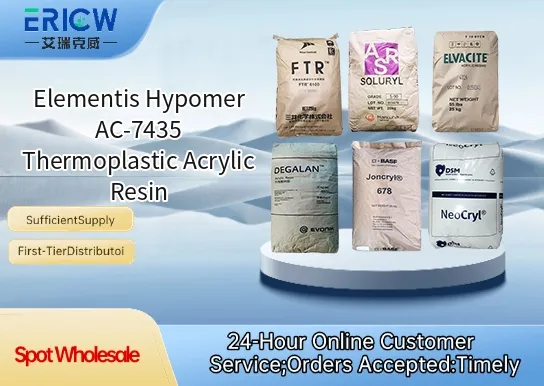
Excellent clarity and gloss retention in transparent coatings and films
Good solubility in common organic solvents including esters, ketones, and aromatic hydrocarbons
High molecular weight thermoplastic acrylic offering enhanced film hardness and abrasion resistance
Low yellowing tendency under UV exposure and thermal aging
Compatible with nitrocellulose, CAB, and other common film-formers for hybrid systems
Automotive refinish clearcoats and basecoat binders
Industrial maintenance coatings for metal and plastic substrates
Flexible packaging inks requiring high gloss and mar resistance
Wood finishing topcoats where clarity and sandability are critical
Specialty graphic arts inks and overprint varnishes
| Chemical Type | Thermoplastic acrylic copolymer |
| Product Form | Free-flowing granular solid |
| Appearance | Off-white to light amber granules |
| Primary Applications | Clearcoats, industrial coatings, specialty inks |
| Key Features | High clarity, solvent solubility, thermoplastic film formation |
| Benefits | Enhanced hardness, UV stability, formulation flexibility |
| Solvent Resistance | Good resistance to aliphatic hydrocarbons; moderate resistance to alcohols |
| Storage Stability | Stable under dry, cool conditions (≤30°C) for ≥12 months |
Q1: What is the primary function of Hypomer AC-7435 in coating and ink formulations?
A: Hypomer AC-7435 functions primarily as a rheology modifier and film-forming aid, enhancing viscosity control, leveling, and substrate wetting while contributing to improved mar resistance and gloss retention in thermoplastic acrylic-based systems.
Q2: Is Hypomer AC-7435 compatible with common solvent-based and water-reducible systems?
A: Yes — Hypomer AC-7435 demonstrates good compatibility with a broad range of organic solvents (e.g., esters, ketones, aromatic hydrocarbons) and can be effectively incorporated into water-reducible acrylic dispersions when properly predispersed or emulsified.
Q3: How should Hypomer AC-7435 be incorporated into a formulation to ensure optimal performance?
A: It is recommended to pre-disperse Hypomer AC-7435 in a suitable carrier solvent or resin solution under moderate agitation before adding to the main batch. Avoid high-shear dispersion at elevated temperatures to prevent premature thermal softening or agglomeration.
Q4: Does Hypomer AC-7435 require post-cure or thermal treatment to develop full film properties?
A: As a thermoplastic acrylic resin, Hypomer AC-7435 develops its final film integrity through physical coalescence and solvent evaporation — no chemical crosslinking or thermal cure is required, though mild heat-assisted drying may accelerate film formation in certain applications.
Contact With Us:
E-mail: wangxingqiang@ericwchem.com
Have a Questions? Call Us:
Add:
Building A1, Jiete Industrial Park, Huangpu District, Guangzhou City, Guangdong Province, China