English
 Español
 tiếng việt
 русский
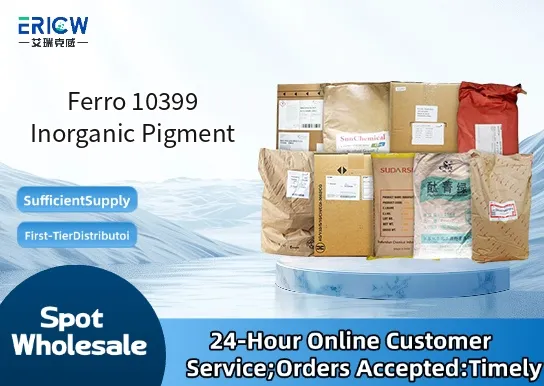
High thermal stability suitable for ceramic and glass firing processes up to 1200 °C.
Excellent lightfastness and UV resistance, ensuring long-term color retention in outdoor applications.
Chemically inert formulation compatible with acidic and alkaline glazes and enamel systems.
Consistent particle size distribution for uniform dispersion and reproducible batch-to-batch color performance.
Non-toxic and heavy-metal-free composition compliant with global regulatory standards including EN 71-3 and RoHS.
Ceramic glazes for tableware and sanitaryware manufacturing.
Colorants in architectural tile bodies and engobes.
Pigmentation of low-firing decorative glass enamels.
Functional coloring agent in refractory coatings and kiln furniture.
Stable chromophore in porcelain enamel formulations for appliance and industrial metal substrates.
| Chemical Type | Mixed-metal oxide (spinel-based) |
| Product Form | Free-flowing fine powder |
| Appearance | Uniform dark brown to black granular powder |
| Primary Applications | Ceramic glazes, glass enamels, porcelain enamels |
| Key Features | Thermal stability, chemical inertness, non-volatility |
| Benefits | Color consistency, minimal batch variation, no fuming during firing |
| pH (10% aqueous slurry) | 6.8–7.4 |
| Moisture Content (max) | 0.5 wt% |
Q1: What is the primary chemical composition of Ferro 10399?
A: Ferro 10399 is a high-performance inorganic pigment based on a complex metal oxide system, engineered for thermal and chemical stability. Its exact formulation is proprietary, but it does not contain regulated heavy metals such as lead, cadmium, or hexavalent chromium.
Q2: Is Ferro 10399 suitable for use in food-contact plastics?
A: Yes, Ferro 10399 is designed to meet global regulatory expectations for pigments used in food-contact applications, including compliance with FDA 21 CFR §178.3297 and relevant EU framework requirements for inorganic colorants. Final regulatory acceptance depends on the full formulation and intended end-use conditions.
Q3: How does Ferro 10399 perform under high-temperature processing?
A: This pigment exhibits excellent thermal stability and retains its color integrity during standard polymer processing operations—including injection molding, extrusion, and blow molding—at temperatures up to 300°C. It shows minimal color shift or degradation even under extended residence times typical in compounding.
Q4: What types of polymers is Ferro 10399 commonly used with?
A: Ferro 10399 demonstrates broad compatibility with engineering thermoplastics such as polypropylene (PP), polyethylene (PE), polyethylene terephthalate (PET), and polycarbonate (PC). It is also successfully incorporated into thermoset systems and masterbatch formulations.
Contact With Us:
E-mail: wangxingqiang@ericwchem.com
Have a Questions? Call Us:
Add:
Building A1, Jiete Industrial Park, Huangpu District, Guangzhou City, Guangdong Province, China