English
 Español
 tiếng việt
 русский
High chroma and excellent color strength in demanding pigmentary applications.
Outstanding thermal stability up to 280 °C, suitable for high-temperature polymer processing.
Good lightfastness and weather resistance in outdoor-relevant formulations.
Excellent dispersion stability in both polar and non-polar media, including polyolefins and engineering plastics.
Low volatility and minimal plate-out tendency during extrusion and injection molding.
Polypropylene (PP) and polyethylene (PE) fibers and films.
Engineering thermoplastics such as ABS, PS, and PC blends.
Automotive interior components requiring long-term color retention.
Consumer electronics housings and durable goods requiring consistent hue and gloss.
Masterbatch production for color concentrate applications.
| Chemical Type | Benzimidazolone derivative |
| Product Form | Free-flowing powder |
| Appearance | Reddish-orange fine powder |
| Primary Applications | Polyolefins, engineering plastics, masterbatches |
| Key Features | High thermal stability, excellent dispersibility, low migration |
| Benefits | Consistent coloration, reduced processing defects, extended product lifetime |
| Regulatory Compliance | REACH registered; compliant with FDA 21 CFR §178.3297 for indirect food contact (subject to formulation) |
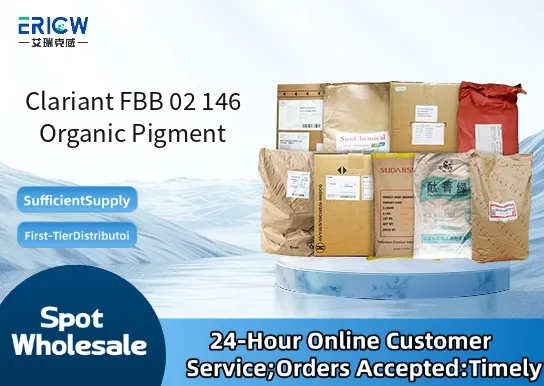
Q1: What is the primary chemical class and hue profile of Clariant FBB 02 146?
A: Clariant FBB 02 146 is a high-performance perylene-based organic pigment, delivering a clean, bluish red shade with excellent chroma and strong tinting strength. Its molecular structure provides inherent resistance to heat, light, and migration in demanding polymer systems.
Q2: In which polymer matrices is FBB 02 146 most commonly processed?
A: This pigment demonstrates excellent dispersibility and thermal stability in engineering thermoplastics such as polyamide (PA6, PA66), polybutylene terephthalate (PBT), and polyethylene terephthalate (PET). It is also widely used in polyolefins (PP, HDPE) for applications requiring good processing stability up to 300 °C.
Q3: Is FBB 02 146 suitable for food-contact or regulatory-sensitive applications?
A: FBB 02 146 is not certified for direct food-contact use under major global food-contact regulations. It is intended for non-food-contact industrial and decorative applications, including automotive interior parts, technical components, and consumer goods where regulatory compliance focuses on mechanical performance and appearance rather than migration limits.
Q4: What is the recommended dosage range for optimal color development and dispersion stability?
A: Typical dosage ranges from 0.1% to 2% by weight depending on the polymer matrix, desired opacity, and processing conditions. Lower concentrations are often sufficient due to its high tinctorial strength, while higher loadings may be used to achieve full hiding power—always validated via lab-scale dispersion trials.
Contact With Us:
E-mail: wangxingqiang@ericwchem.com
Have a Questions? Call Us:
Add:
Building A1, Jiete Industrial Park, Huangpu District, Guangzhou City, Guangdong Province, China