English
 Español
 tiếng việt
 русский
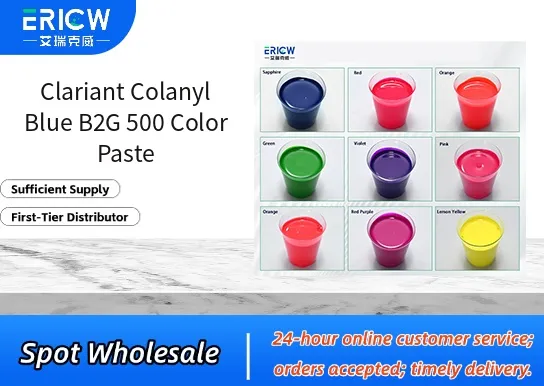
High chroma, clean phthalocyanine blue shade with excellent lightfastness and weather resistance.
Optimized for stable dispersion in water-based and solvent-based systems without flocculation or settling.
Low volatile organic compound (VOC) content, supporting compliance with stringent environmental regulations.
Excellent compatibility with common acrylic, vinyl, and alkyd resin systems.
Consistent batch-to-batch color strength and rheological behavior for reliable production scaling.
Architectural and industrial waterborne coatings.
Automotive refinish basecoats and clearcoat tints.
Plastic coloration for ABS, PS, and PVC compounds.
Printing inks for packaging and label applications.
Wood stains and transparent decorative finishes.
| Chemical Type | Copper phthalocyanine pigment dispersion |
| Product Form | Paste (liquid concentrate) |
| Appearance | Viscous, homogeneous blue paste |
| Primary Applications | Waterborne and solventborne coatings, plastics, inks |
| Key Features | High tinting strength, low viscosity, non-bleeding |
| Benefits | Reduced formulation complexity, improved color consistency, simplified dosing |
| VOC Content | <10 g/L (as per ISO 11890-2) |
| Storage Stability | 12 months at 5–30 °C in sealed original container |
Q1: What types of polymer systems is Colanyl Blue B2G 500 compatible with?
A: Colanyl Blue B2G 500 is formulated for use in polyolefins—including PP and HDPE—as well as certain engineering thermoplastics such as ABS and PS. It demonstrates good thermal stability during standard extrusion and injection molding processes.
Q2: How should this color paste be incorporated into a polymer formulation?
A: The paste is typically added directly to the base polymer using standard masterbatch dilution techniques—such as twin-screw extrusion or high-speed mixing—ensuring uniform dispersion. Pre-drying is not required, but handling under low-humidity conditions is recommended to maintain consistency.
Q3: Is Colanyl Blue B2G 500 suitable for applications requiring regulatory compliance for food contact or toys?
A: This product is designed for industrial and general-purpose applications. For regulated end-uses—including food-contact plastics or children’s products—formulators must conduct full system-level compliance verification, as regulatory approval depends on final composition, processing conditions, and intended application.
Q4: What is the typical dosage range when using this paste in polyolefin applications?
A: Dosage depends on the desired shade intensity and base polymer characteristics, but it is generally used at low concentrations—typically ranging from 0.1% to 2% by weight relative to the total formulation.
Contact With Us:
E-mail: wangxingqiang@ericwchem.com
Have a Questions? Call Us:
Add:
Building A1, Jiete Industrial Park, Huangpu District, Guangzhou City, Guangdong Province, China