English
 Español
 tiếng việt
 русский
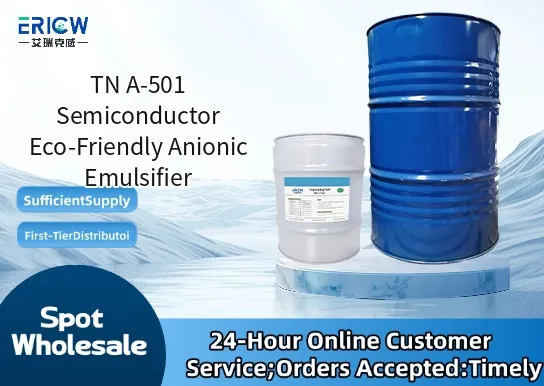
Highly effective anionic surfactant specifically engineered for semiconductor-grade aqueous cleaning and dispersion processes.
Zero halogen, non-phosphorous, and free of heavy metals—designed to meet stringent semiconductor fab environmental and purity requirements.
Low foaming profile ensures compatibility with high-shear recirculation systems and ultrasonic cleaning equipment.
Excellent hydrolytic stability across pH 4–10 and elevated temperatures up to 80 °C.
Readily biodegradable (OECD 301D compliant) with low aquatic toxicity (EC50 > 100 mg/L, Daphnia magna).
Photoresist stripper formulations for advanced node (≤28 nm) wafer cleaning.
Post-etch residue removal in copper/low-k interconnect processing.
Stabilizer for aqueous-based CMP (Chemical Mechanical Polishing) slurry additives.
Emulsifying agent in eco-friendly metal oxide nanoparticle dispersions for thin-film coating precursors.
Co-surfactant in low-VOC, water-dilutable photoresist removers for 300 mm wafer lines.
| Chemical Type | Sulfosuccinate-based anionic surfactant (branched alkyl ester) |
| Product Form | Pale yellow to amber viscous liquid |
| Appearance | Clear, homogeneous liquid; slight characteristic odor |
| pH (1% aqueous solution, 25 °C) | 6.2 – 7.0 |
| Active Content (by weight) | ≥ 48.0% |
| Primary Applications | Semiconductor wet cleaning, residue emulsification, nanoparticle stabilization |
| Key Features | Halogen-free, non-alkylphenol, low volatility, ultra-low sodium residue (<5 ppm) |
| Regulatory Compliance | REACH registered; RoHS 2.0 compliant; no SVHC on current ECHA Candidate List |
| Common Compatible Systems | Suitability |
| Aqueous alkaline photoresist strippers (e.g., amine-based) | Highly Recommended – Maintains emulsion stability without phase separation or salt precipitation |
| Organic acid-based post-etch cleaners (e.g., citric/malic blends) | Recommended – Requires pH buffering above 4.5 for optimal performance |
| Water-based CMP slurries (SiO₂ & CeO₂) | Highly Recommended – Enhances particle dispersion and reduces agglomeration at ≤0.1 wt% |
| Non-ionic co-surfactant systems (e.g., C12–C14 alcohol ethoxylates) | Suitable – Synergistic foam control and improved soil suspension below CMC |
Q1: What is the CAS Registry Number for TN A-501?
A: The CAS Number for TN A-501 is 1289321-87-4. This unique identifier corresponds to its specific sulfosuccinate diester molecular structure and is verified in the REACH dossier.
Q2: What is the typical usage concentration range in semiconductor cleaning formulations?
A: Recommended dosage is 0.05–0.5 wt% in final diluted working solutions (e.g., 1:10 to 1:50 dilution), depending on soil load and process temperature. For concentrated stock solutions, use 5–15 wt%.
Q3: How does TN A-501 compare to traditional alkylphenol ethoxylates (APEOs) in terms of performance and compliance?
A: Unlike APEOs—which are banned under EU Directive 2023/2006 and prohibited in all Tier-1 semiconductor supply chains—TN A-501 delivers comparable emulsification efficiency with zero endocrine-disrupting potential, full biodegradability, and no detectable nonylphenol migration under ICP-MS testing (detection limit <0.1 ppb).
Q4: Has TN A-501 been evaluated for extractables and leachables in contact with high-purity process water systems?
A: Yes. Per SEMI F57-0322 testing protocols, TN A-501 shows no detectable organic extractables (by GC-MS and LC-HRMS) after 72 h immersion in UPW (18.2 MΩ·cm) at 25 °C, confirming suitability for critical rinse and tool purge applications.
Contact With Us:
E-mail: wangxingqiang@ericwchem.com
Have a Questions? Call Us:
Add:
Building A1, Jiete Industrial Park, Huangpu District, Guangzhou City, Guangdong Province, China