English
 Español
 tiếng việt
 русский
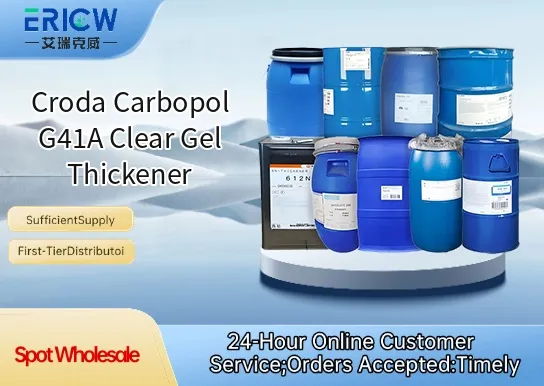
High clarity and transparency in aqueous systems, ideal for premium clear gels.
Excellent rheology control with strong pseudoplastic behavior and high suspension capability.
Efficient thickening at low use levels (typically 0.2–1.0% w/w), reducing formulation cost and viscosity overshoot.
Compatible with a broad pH range (3.0–7.5) and stable in the presence of electrolytes and common preservatives.
Easy dispersion and rapid hydration without grit or lumps when neutralized with standard bases (e.g., NaOH, TEA).
Clear hand sanitizers and antiseptic gels.
Premium facial cleansers and toning gels.
Transparent hair styling gels and setting lotions.
Water-based pharmaceutical gels (e.g., topical analgesics and dermatological vehicles).
Clear cosmetic serums and hydrating gel creams.
| Chemical Type | Acrylate crosspolymer (carbomer) |
| Product Form | Free-flowing white powder |
| Appearance | White to off-white, free-flowing granular powder |
| Primary Applications | Clear aqueous gels for personal care and pharmaceuticals |
| Key Features | High clarity, low residue, rapid dispersion, excellent suspension |
| Benefits | Reduced formulation time, improved sensory profile, enhanced stability |
| pH Range (Neutralized Gel) | 3.0 – 7.5 |
| Solubility | Insoluble in water until neutralized; forms clear, viscous gels upon neutralization |
Q1: What is the primary function of Carbopol G41A in formulations?
A: Carbopol G41A is a high-purity, crosslinked acrylic acid polymer designed to provide efficient viscosity enhancement and gel structure in aqueous systems. It delivers excellent clarity, smooth rheology, and robust suspension capability—particularly valued in transparent gels and low-irritancy personal care products.
Q2: How is Carbopol G41A different from standard Carbopol grades like 940 or 980?
A: G41A is specifically engineered for enhanced clarity and reduced residual monomer content, making it suitable for premium clear gel applications where optical performance and mildness are critical. Its optimized particle size distribution and neutralization profile support faster dispersion and more consistent gel formation compared to conventional grades.
Q3: What neutralizing agents are recommended for optimal performance?
A: Sodium hydroxide (NaOH), triethanolamine (TEA), and sodium bicarbonate are commonly used neutralizers. The choice depends on formulation pH targets, sensory profile, and compatibility with other ingredients. TEA often provides a smoother, less tacky feel, while NaOH offers precise pH control and high clarity.
Q4: Is Carbopol G41A compatible with common preservatives and surfactants?
A: Yes—G41A demonstrates broad compatibility with widely used preservative systems (e.g., parabens, phenoxyethanol blends) and both anionic and nonionic surfactants. However, strong cationic actives or high electrolyte concentrations may reduce viscosity; formulation testing under intended use conditions is recommended.
Q5: What is the typical dosage range for achieving effective thickening?
A: Dosage generally ranges from 0.1% to 2.0% by weight, depending on desired viscosity, water quality, neutralizer type, and presence of co-thickeners or solubilizers. It is typically used at low concentrations due to its high efficiency and strong thickening power in neutralized aqueous media.
Contact With Us:
E-mail: wangxingqiang@ericwchem.com
Have a Questions? Call Us:
Add:
Building A1, Jiete Industrial Park, Huangpu District, Guangzhou City, Guangdong Province, China