English
 Español
 tiếng việt
 русский
High solids content for reduced VOC emissions and improved coating efficiency.
Excellent UV resistance and long-term gloss retention in outdoor applications.
Superior compatibility with common crosslinkers including melamine and polyisocyanates.
Good flow and leveling characteristics for smooth, defect-free film formation.
Enhanced hydrolytic stability due to optimized ester backbone design.
Automotive OEM and refinish topcoats.
Industrial maintenance coatings for metal substrates.
Architectural high-performance exterior wall paints.
Plastic coatings requiring adhesion and flexibility.
Can coatings for food and beverage packaging.
| Chemical Type | Thermosetting acrylic copolymer |
| Product Form | Liquid resin solution |
| Appearance | Clear, colorless to pale yellow liquid |
| Solids Content (wt%) | 50–55% (as supplied) |
| Acid Value (mg KOH/g) | 8–12 |
| Viscosity (mPa·s, 25°C) | 3,000–6,000 |
| Specific Gravity (25°C) | 1.02–1.06 |
| Primary Applications | High-gloss decorative and protective coatings |
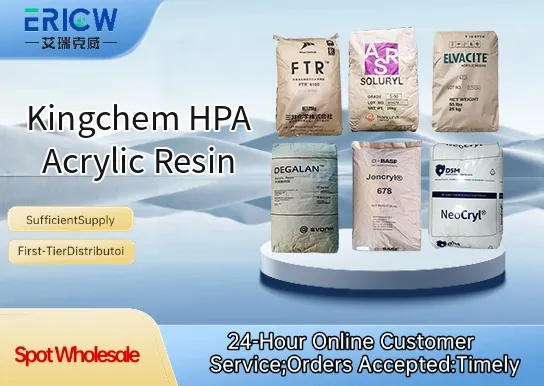
Q1: What is the primary function of Kingchem HPA Acrylic Resin in coating formulations?
A: Kingchem HPA Acrylic Resin serves as a high-performance hydrophobic additive that enhances water resistance, improves surface durability, and contributes to long-term film integrity—particularly in architectural, industrial, and protective coatings exposed to humid or wet conditions.
Q2: Is Kingchem HPA Acrylic Resin compatible with both solvent-based and waterborne systems?
A: Yes—it is engineered for broad compatibility across aqueous dispersions, acrylic emulsions, and conventional solvent-based resins. Optimal incorporation typically requires pre-dilution in a compatible carrier solvent or co-solvent before addition to the main formulation.
Q3: How does Kingchem HPA Acrylic Resin differ from standard acrylic modifiers?
A: Unlike conventional acrylic co-polymers, Kingchem HPA features a tailored hydrophobic architecture with enhanced alkyl chain density and controlled crosslinking potential, delivering superior moisture barrier properties without compromising film clarity or flexibility.
Q4: What are recommended storage conditions to maintain product stability?
A: Store in original sealed containers at temperatures between 5 °C and 30 °C, away from direct sunlight and sources of heat or ignition. Prolonged exposure to freezing temperatures or excessive humidity may affect viscosity and dispersibility.
Contact With Us:
E-mail: wangxingqiang@ericwchem.com
Have a Questions? Call Us:
Add:
Building A1, Jiete Industrial Park, Huangpu District, Guangzhou City, Guangdong Province, China