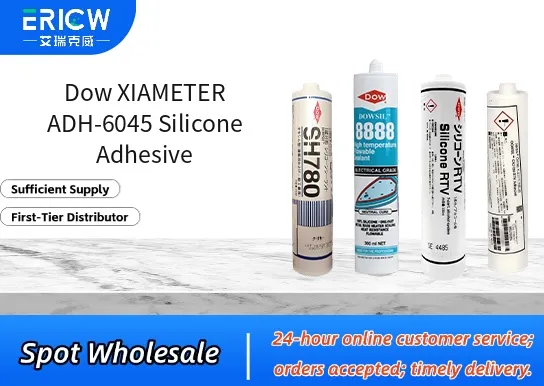
Features Of Dow XIAMETER ADH-6045 Silicone Adhesive
High-performance, one-component, moisture-curing silicone adhesive with excellent adhesion to low-surface-energy substrates.
Offers outstanding resistance to thermal cycling, UV exposure, and weathering over extended service life.
Low modulus formulation provides superior flexibility and stress relief in bonded assemblies subject to vibration or thermal expansion.
Non-corrosive and acetoxy-free cure chemistry—safe for sensitive metals, electronics, and optical components.
Good flow and gap-filling capability with controlled tack time for reliable manual or automated dispensing.
Typical Applications Of Dow XIAMETER ADH-6045 Silicone Adhesive
Automotive lighting assemblies—including headlamp and taillamp lens-to-housing bonding.
Electronics encapsulation and structural bonding of sensors, displays, and housings in harsh environments.
Architectural glazing and curtain wall systems requiring durable, elastic, and weather-resistant seals.
Medical device assembly where biocompatibility support and low-ionic extractables are critical.
Industrial appliance bonding—such as control panels, nameplates, and trim on white goods and HVAC units.
Specifications Of Dow XIAMETER ADH-6045 Silicone Adhesive
| Chemical Type | One-part, condensation-cure, alkoxy-functional silicone polymer |
| Product Form | Paste-like, thixotropic adhesive in cartridge or bulk packaging |
| Appearance | Opaque, off-white to light gray paste |
| Primary Applications | Structural bonding, sealing, and gasketing of dissimilar substrates |
| Key Features | Low modulus, non-corrosive, UV-stable, flexible, good adhesion without primer |
| Benefits | Reduces assembly stress, eliminates post-cure requirements, supports high-yield manufacturing |
| Cure Mechanism | Moisture-cured at ambient temperature; full cure typically achieved within 7 days (25°C/50% RH) |
| Shelf Life | 9 months unopened at ≤25°C in original sealed container |
Dow XIAMETER ADH-6045 Silicone Adhesive – Frequently Asked Questions (FAQ)
Q1: What substrates does ADH-6045 bond effectively to?
A: ADH-6045 is formulated to provide strong adhesion to a broad range of low-surface-energy substrates, including polyolefins (e.g., PP and PE), fluoropolymers (e.g., PTFE), and silicone elastomers. It also enhances bonding to metals, glass, and certain engineered plastics when used as a primer or adhesion promoter.
Q2: How is ADH-6045 typically applied in manufacturing processes?
A: ADH-6045 is commonly applied via spray, dip, roll-coat, or screen-printing methods prior to curing. It is designed for integration into high-speed industrial processes and cures thermally—typically during subsequent vulcanization or post-bake steps—without requiring separate UV exposure or catalyst addition.
Q3: Can ADH-6045 be used in high-temperature applications?
A: Yes—once fully cured, adhesive bonds formed with ADH-6045 retain integrity across a wide service temperature range, supporting long-term performance in environments exceeding 200 °C. Its silicone backbone contributes to thermal stability and resistance to oxidative degradation.
Q4: Is ADH-6045 compatible with platinum-cure and peroxide-cure silicone systems?
A: ADH-6045 is broadly compatible with both platinum-cure and peroxide-cure silicone formulations. It does not inhibit platinum catalysis at recommended use levels and remains stable under typical peroxide cure conditions. Compatibility should always be verified in the final formulation due to potential interactions with other additives.
 English
 Español
 tiếng việt
 русский