English
 Español
 tiếng việt
 русский
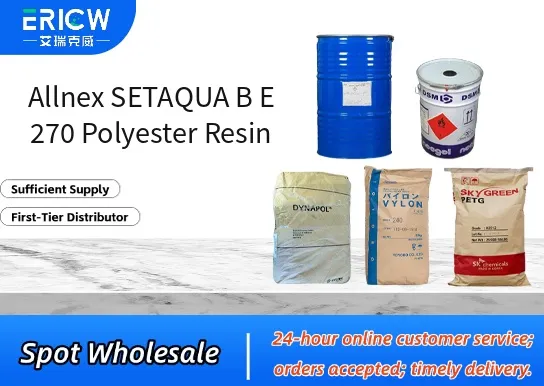
Waterborne polyester dispersion offering excellent hydrolytic stability and low VOC content.
Designed for high-gloss, durable clearcoats with superior hardness and scratch resistance.
Enables fast ambient or low-bake curing (e.g., 60–80 °C), supporting energy-efficient production.
Provides outstanding compatibility with melamine crosslinkers and common waterborne acrylics.
Delivers balanced film formation, flow, and leveling without excessive co-solvent demand.
Automotive refinish clearcoats (waterborne basecoat/clearcoat systems).
Industrial wood coatings for furniture, cabinetry, and interior joinery.
Plastic coatings for automotive interior trim and consumer electronics housings.
General-purpose protective coatings for metal substrates in architectural and appliance applications.
| Chemical Type | Waterborne polyester dispersion |
| Product Form | Opaque white to light yellow liquid |
| Appearance | Homogeneous aqueous dispersion |
| Solids Content (wt%) | 35–37% |
| pH | 7.5–8.5 |
| Viscosity (mPa·s, Brookfield RVT, #2 spindle, 20 rpm) | 150–400 |
| Density (g/cm³, 20 °C) | 1.02–1.05 |
| Primary Applications | High-performance waterborne clearcoats and topcoats |
Q1: What is the primary application of SETAQUA B E 270 in waterborne coatings?
A: SETAQUA B E 270 is a water-reducible polyester resin designed primarily for high-performance, low-VOC industrial maintenance and protective coatings, including metal primers and topcoats where good gloss retention, flexibility, and corrosion resistance are required.
Q2: Is SETAQUA B E 270 compatible with common waterborne crosslinkers?
A: Yes, it is formulated to be compatible with standard waterborne amino resins and polyisocyanate crosslinkers, enabling robust cure performance at ambient or elevated temperatures depending on the system design.
Q3: How should SETAQUA B E 270 be dispersed or diluted in aqueous systems?
A: It is typically added to water under moderate agitation and may require pH adjustment (e.g., with tertiary amines) to achieve stable dispersion. Pre-dilution with deionized water is recommended before incorporation into the full formulation.
Q4: Does SETAQUA B E 270 offer good compatibility with pigments and fillers?
A: Yes, it demonstrates good wetting and stabilization properties for common inorganic pigments and extenders used in industrial waterborne coatings, supporting formulations with low settling tendency and acceptable rheology.
Contact With Us:
E-mail: wangxingqiang@ericwchem.com
Have a Questions? Call Us:
Add:
Building A1, Jiete Industrial Park, Huangpu District, Guangzhou City, Guangdong Province, China