English
 Español
 tiếng việt
 русский
High-gloss, excellent flow and leveling for smooth, defect-free coatings.
Outstanding weather resistance and UV stability for long-term outdoor performance.
Good chemical resistance to common household cleaners and mild industrial agents.
Optimized reactivity for efficient curing with TGIC-free crosslinkers in powder systems.
Consistent batch-to-batch reproducibility ensuring reliable manufacturing scale-up.
Architectural aluminum extrusions (e.g., window frames, curtain walls).
Automotive exterior trim and non-under-hood components.
Outdoor furniture and garden equipment coatings.
Consumer electronics enclosures requiring aesthetic durability.
General industrial metal finishing for high-end appliances and fixtures.
| Chemical Type | Carboxyl-functional saturated polyester |
| Product Form | Free-flowing white to off-white granules |
| Appearance | Homogeneous granular solid |
| Acid Value (mg KOH/g) | 27–31 |
| Glass Transition Temperature (°C) | 68–72 |
| Molecular Weight (Mn) | 2,400–2,800 |
| Primary Applications | TGIC-free and HAA-cured powder coatings |
| Key Features | High gloss, UV resistance, excellent flow, weather durability |
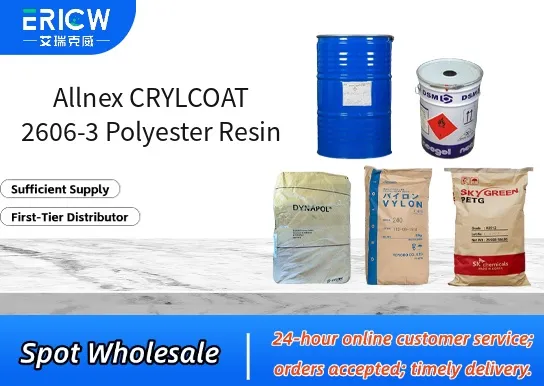
Q1: What is the primary application of CRYLCOAT 2606-3 in powder coating systems?
A: CRYLCOAT 2606-3 is a carboxyl-functional polyester resin specifically designed as a binder for TGIC-free, high-gloss, exterior-grade thermosetting powder coatings—commonly used for architectural aluminum extrusions, façade panels, and outdoor furniture where weather resistance and long-term color retention are critical.
Q2: Is CRYLCOAT 2606-3 compatible with standard epoxy-based curing agents?
A: No—CRYLCOAT 2606-3 is formulated for use with alternative crosslinkers such as β-hydroxyalkylamide (HAA) or hydroxy-functional acrylics, not epoxy resins. Its carboxyl functionality and molecular design optimize reactivity and film performance with HAA-type hardeners in TGIC-free systems.
Q3: How does CRYLCOAT 2606-3 support exterior durability in powder coatings?
A: It delivers excellent UV stability, chalking resistance, and gloss retention under accelerated weathering tests due to its saturated aliphatic backbone and controlled molecular architecture—making it suitable for demanding outdoor applications without relying on TGIC or aromatic modifiers.
Q4: Can CRYLCOAT 2606-3 be blended with other polyester resins to modify performance?
A: Yes—formulators commonly blend CRYLCOAT 2606-3 with complementary carboxyl-functional polyesters to fine-tune flow, leveling, mechanical properties, or cure response, provided compatibility and stoichiometric balance with the chosen crosslinker are verified during development.
Contact With Us:
E-mail: wangxingqiang@ericwchem.com
Have a Questions? Call Us:
Add:
Building A1, Jiete Industrial Park, Huangpu District, Guangzhou City, Guangdong Province, China