English
 Español
 tiếng việt
 русский
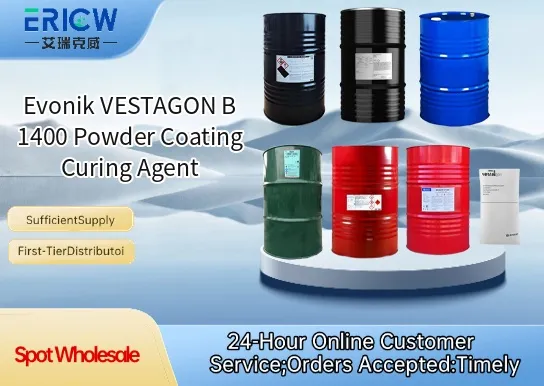
High reactivity with epoxy resins enabling fast cure at low temperatures (160–180 °C).
Excellent flow and leveling performance for smooth, high-gloss finishes.
Low volatility and negligible odor—supports compliant, worker-friendly powder formulations.
Outstanding storage stability in dry powder blends, minimizing pre-cure risk during handling.
Enables high crosslink density for enhanced chemical resistance and mechanical durability.
Architectural metal cladding and façade systems.
Appliance coatings for refrigerators, ovens, and washing machines.
Automotive under-hood components requiring thermal and chemical resistance.
Outdoor furniture and garden equipment with demanding weathering requirements.
Industrial machinery housings and electrical enclosures.
| Chemical Type | Modified imidazole-based latent curing agent |
| Product Form | Fine free-flowing white to off-white powder |
| Appearance | Homogeneous crystalline powder |
| Primary Applications | Epoxy and hybrid (epoxy-polyester) thermoset powder coatings |
| Key Features | Latent reactivity, low-temperature cure, high storage stability |
| Benefits | Energy-efficient curing, excellent film integrity, low VOC impact |
| Recommended Storage | Below 25 °C in dry, sealed containers |
| Shelf Life | 24 months under recommended storage conditions |
Q1: What is the primary chemical functionality of VESTAGON B 1400?
A: VESTAGON B 1400 is a blocked aliphatic polyisocyanate curing agent, where the isocyanate groups are thermally protected by a phenolic blocking agent. It releases active NCO groups upon heating, enabling crosslinking with hydroxyl-functional resins in powder coatings.
Q2: Which resin systems is VESTAGON B 1400 typically compatible with?
A: It is primarily designed for use with hydroxyl-functional polyester and acrylic resins in hybrid and pure polyester powder coating formulations. Compatibility with specific resin grades should be verified through laboratory-scale formulation and cure testing.
Q3: What is the typical recommended cure schedule when using VESTAGON B 1400?
A: A standard thermal cure profile generally ranges from 160–180 °C for 10–20 minutes, depending on film thickness, substrate type, and oven conditions. The exact schedule must be optimized for each formulation to ensure full deblocking and crosslink density.
Q4: How should VESTAGON B 1400 be incorporated into a powder coating formulation?
A: It is added during the dry-blend or extrusion stage, depending on the manufacturing process. Due to its thermal sensitivity, it is recommended to avoid excessive shear or prolonged exposure to elevated temperatures prior to final curing. Pre-blending with carrier resin may improve dispersion uniformity.
Q5: Does VESTAGON B 1400 contribute to improved coating performance properties?
A: Yes — when properly formulated and cured, it supports excellent mechanical properties such as flexibility, impact resistance, and chemical resistance. Its aliphatic backbone also contributes to superior UV stability and gloss retention compared to aromatic alternatives.
Contact With Us:
E-mail: wangxingqiang@ericwchem.com
Have a Questions? Call Us:
Add:
Building A1, Jiete Industrial Park, Huangpu District, Guangzhou City, Guangdong Province, China