English
 Español
 tiếng việt
 русский
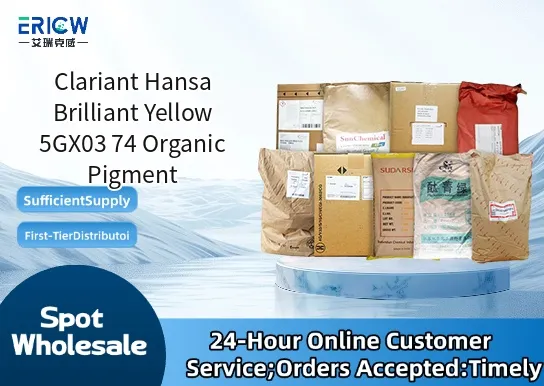
High chroma and clean greenish-yellow hue ideal for vibrant color matching.
Excellent lightfastness and weather resistance in demanding outdoor applications.
Good heat stability up to 160 °C, suitable for medium-temperature polymer processing.
Outstanding dispersibility in both polar and non-polar media, enabling efficient pigment incorporation.
Low migration tendency in PVC, polyolefins, and printing inks, ensuring color integrity over time.
Plastic coloration — especially rigid and flexible PVC, PP, and HDPE.
Industrial coatings — including coil coatings, automotive refinish, and general-purpose architectural paints.
Gravure and flexographic printing inks for packaging and labeling.
Masterbatch production for high-brightness yellow shades in consumer goods and construction materials.
Textile printing pastes for polyester and cellulose-based fabrics requiring vivid yellow tones.
| Chemical Type | Azo pigment (monoazo, β-naphthol derivative) |
| Product Form | Fine free-flowing powder |
| Appearance | Yellow to greenish-yellow powder |
| Primary Applications | Plastics, industrial coatings, printing inks |
| Key Features | High tinctorial strength, good opacity, low oil absorption |
| Benefits | Consistent batch-to-batch performance, regulatory-compliant for selected markets |
| Regulatory Status | Complies with EU REACH; not classified as CMR or SVHC under current listing |
| Recommended Processing Temperature | Up to 160 °C (short-term) |
Q1: What are the primary application areas for Hansa Brilliant Yellow 5GX03 74?
A: This pigment is widely used in industrial coatings, printing inks (especially offset and gravure), and plastics applications where high brightness, good lightfastness, and clean yellow shade are required. It is not recommended for food-contact or pharmaceutical applications unless specifically qualified by the end-user.
Q2: How does this pigment perform in heat-sensitive polymer systems?
A: Hansa Brilliant Yellow 5GX03 74 demonstrates moderate thermal stability and is generally suitable for processing temperatures up to approximately 160–180 °C, depending on residence time and matrix composition. For high-heat polymers like engineering resins, stabilization additives or alternative pigments may be preferred.
Q3: Is this pigment compatible with water-based and solvent-based systems?
A: Yes — it is commonly formulated into both aqueous dispersions and solvent-based pastes. Compatibility and dispersion stability depend on appropriate surfactant selection and milling conditions; Clariant recommends conducting compatibility testing in the target vehicle prior to full-scale integration.
Q4: What level of UV resistance can be expected in outdoor coating applications?
A: While offering good initial color strength and brightness, Hansa Yellow 5GX03 74 has only moderate inherent UV resistance. For extended exterior exposure, it is typically used with UV absorbers or HALS stabilizers, or replaced with more durable azo or non-azo alternatives.
Q5: What is the typical dosage range when incorporating this pigment into plastic masterbatches?
A: Dosage varies significantly by polymer type, desired shade intensity, and processing method, but generally ranges from 0.1% to 2% by weight. Optimal loading should be determined through lab-scale trials to balance color development, dispersion quality, and potential impact on mechanical properties.
Contact With Us:
E-mail: wangxingqiang@ericwchem.com
Have a Questions? Call Us:
Add:
Building A1, Jiete Industrial Park, Huangpu District, Guangzhou City, Guangdong Province, China