English
 Español
 tiếng việt
 русский
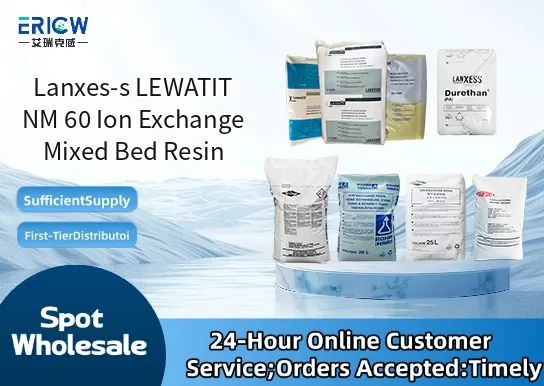
Optimized cation/anion resin ratio for ultra-high purity water production with resistivity up to 18.2 MΩ·cm.
Pre-mixed and thoroughly blended in factory-controlled conditions to ensure consistent performance and reproducible regeneration behavior.
Low total organic carbon (TOC) extractables, minimizing post-treatment contamination risk in sensitive applications.
Excellent physical and chemical stability across wide pH range (0–14), supporting robust long-term operation.
Designed for use in polished deionization (DI) units requiring minimal footprint and high throughput efficiency.
Final polishing stage in ultrapure water (UPW) systems for semiconductor manufacturing.
Pharmaceutical-grade water production meeting USP <751>, EP 2.2.39, and JP standards.
Power plant boiler feedwater polishing to prevent corrosion and scaling in high-pressure steam cycles.
Laboratory water purification systems requiring Type I reagent water per ISO 3696:1995.
Electronics cleaning rinse water where low ionic and particulate contamination is critical.
| Chemical Type | Strong acid cation (H⁺ form) / strong base anion (OH⁻ form) mixed bed |
| Product Form | Uniform spherical beads, pre-mixed and ready-to-use |
| Appearance | Opaque light amber (cation) and off-white (anion) beads; visually homogeneous blend |
| Primary Applications | Ultrapure water polishing, pharmaceutical water, power generation, microelectronics |
| Key Features | Low TOC release, high exchange capacity, excellent regeneration efficiency |
| Benefits | Reduced downtime, extended service run length, compliance with stringent water quality standards |
| Storage Conditions | Store dry at 5–40 °C; avoid freezing and direct sunlight |
| Regeneration Compatibility | Compatible with standard acid (HCl/H₂SO₄) and alkali (NaOH) regenerants |
Q1: What is the primary application of Lanxes-s LEWATIT NM 60?
A: Lanxes-s LEWATIT NM 60 is a pre-mixed, ready-to-use ion exchange resin specifically designed for high-purity water polishing applications—commonly deployed in pharmaceutical, biotechnology, and electronics-grade ultrapure water systems where consistent deionization performance and low particle release are critical.
Q2: How does Lanxes-s LEWATIT NM 60 differ from conventional mixed bed resins?
A: Unlike standard mixed beds requiring on-site blending of cationic and anionic resins, Lanxes-s LEWATIT NM 60 features a precisely balanced, factory-premixed composition with optimized particle size distribution and uniform density—enabling stable bed stratification, reduced pressure drop, and extended service cycles under continuous operation.
Q3: Is Lanxes-s LEWATIT NM 60 suitable for steam generation or high-temperature service?
A: Lanxes-s LEWATIT NM 60 is formulated for ambient to moderately elevated temperature operation typical of polished water loops (up to approximately 50 °C). It is not recommended for direct use in high-pressure boiler feedwater or sustained steam-phase environments without prior system compatibility assessment.
Q4: What regeneration protocol is required?
A: Lanxes-s LEWATIT NM 60 is intended for single-use, disposable operation in sealed or semi-closed polishing vessels. It is not designed for on-site acid/alkali regeneration due to its pre-balanced stoichiometry and risk of cross-contamination between resin fractions during chemical treatment.
Contact With Us:
E-mail: wangxingqiang@ericwchem.com
Have a Questions? Call Us:
Add:
Building A1, Jiete Industrial Park, Huangpu District, Guangzhou City, Guangdong Province, China