English
 Español
 tiếng việt
 русский
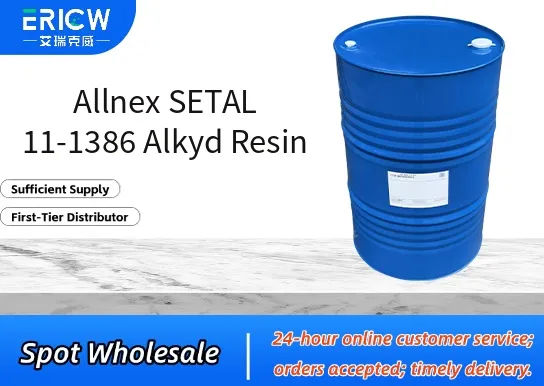
Medium-oil-length alkyd resin based on phthalic anhydride and soybean oil fatty acids.
Designed for excellent gloss retention and long-term durability in air-drying coatings.
Offers balanced drying speed and film hardness development for efficient production workflows.
Compatible with common solvents, pigments, and co-resins including melamine formaldehyde and urea-formaldehyde.
Delivers good flexibility and impact resistance in finished coating films.
General-purpose industrial maintenance coatings.
Original equipment manufacturer (OEM) coatings for metal furniture and agricultural equipment.
Air-drying decorative enamels for architectural and consumer goods applications.
Undercoats and primers requiring good sandability and intercoat adhesion.
Low-VOC solventborne topcoats where balanced performance and regulatory compliance are essential.
| Chemical Type | Phthalic–soybean oil alkyd resin |
| Product Form | Liquid |
| Appearance | Clear to slightly hazy amber liquid |
| Non-Volatile Content (wt%) | ~60% (in xylene) |
| Viscosity (mPa·s, 25°C) | 1,200–1,800 |
| Acid Value (mg KOH/g) | 6–10 |
| Iodine Value (g I₂/100 g) | 120–140 |
| Solubility | Compatible with aromatic hydrocarbons, ketones, and esters |
Q1: What is the primary application area for SETAL 11-1386?
A: SETAL 11-1386 is a medium-oil-length alkyd resin designed primarily for solventborne industrial maintenance and protective coatings, including general-purpose primers, undercoats, and mid-coats where balanced drying performance, gloss retention, and substrate adhesion are required.
Q2: Is SETAL 11-1386 compatible with common crosslinkers used in industrial coatings?
A: Yes — it is formulated to be compatible with standard amino resins (e.g., melamine-formaldehyde) and can also be used in air-drying or cobalt-catalyzed oxidative cure systems. Compatibility testing in the final formulation is recommended due to variations in solvent blends and additives.
Q3: How does SETAL 11-1386 perform in terms of drying behavior and film formation?
A: It offers good through-dry characteristics and forms flexible, cohesive films with moderate hardness development. Drying speed is typical of medium-oil alkyds — suitable for ambient-cure applications with acceptable tack-free and handling times under standard conditions.
Q4: Can SETAL 11-1386 be used in high-solids formulations?
A: Yes — its viscosity profile and molecular structure support high-solids coating systems. Formulators may adjust solvent selection and rheology modifiers to achieve target application viscosity while maintaining storage stability and film integrity.
Q5: What types of pigments and additives is SETAL 11-1386 typically compatible with?
A: It demonstrates broad compatibility with conventional inorganic pigments (e.g., titanium dioxide, iron oxides) and common organic pigments. It also works well with standard dispersants, wetting agents, and anti-settling additives — though performance should be verified in full-scale trials given system-specific interactions.
Contact With Us:
E-mail: wangxingqiang@ericwchem.com
Have a Questions? Call Us:
Add:
Building A1, Jiete Industrial Park, Huangpu District, Guangzhou City, Guangdong Province, China