English
 Español
 tiếng việt
 русский
Highly selective palladium-based catalyst optimized for propylene oxide (PO) production via the hydrogen peroxide to propylene oxide (HPPO) process.
Exceptional long-term stability under continuous industrial operation, minimizing deactivation and extending catalyst cycle life.
Low palladium leaching and high resistance to sintering, ensuring consistent performance and reduced metal loss during regeneration.
Engineered support matrix with tailored acidity and pore structure to maximize H₂O₂ utilization efficiency and suppress side reactions.
Designed for seamless integration into existing HPPO reactor systems without requiring major hardware modifications.
Propylene oxide (PO) manufacturing via the hydrogen peroxide to propylene oxide (HPPO) process.
On-purpose PO production for polyether polyols used in flexible and rigid polyurethane foams.
Production of propylene glycol and glycol ethers for coatings, pharmaceuticals, and food-grade applications.
Integrated petrochemical complexes seeking high-yield, low-waste PO synthesis with reduced environmental footprint.
Green chemistry initiatives requiring atom-efficient, water-only byproduct oxidation catalysis.
| Chemical Type | Palladium on functionalized silica-alumina support |
| Product Form | Free-flowing granular solid |
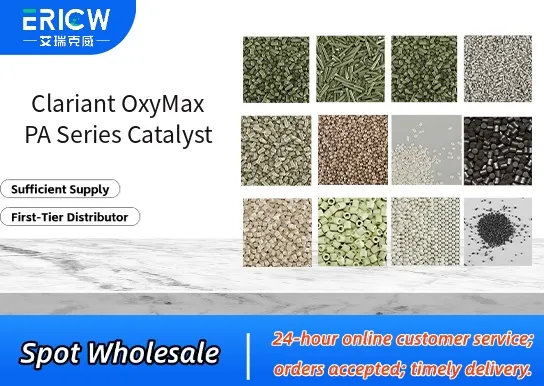
| Appearance | Grayish-black cylindrical pellets (1.5–2.0 mm diameter) |
| Primary Applications | Hydrogen peroxide to propylene oxide (HPPO) process |
| Key Features | High H₂O₂ efficiency (>95%), low propylene carbonate formation, minimal chlorinated impurities |
| Benefits | Reduced wastewater treatment load, lower catalyst consumption per ton of PO, improved plant uptime |
| Storage Conditions | Store in sealed containers at ambient temperature; protect from moisture and direct sunlight |
| Handling Precautions | Use appropriate PPE; avoid inhalation of dust; non-hazardous under normal handling conditions per GHS |
Q1: What is the primary function of the OxyMax PA Series in polymer processing?
A: The OxyMax PA Series is a specialized oxidation catalyst designed to accelerate controlled thermal degradation of polyamide (PA) polymers during compounding and recycling—enabling viscosity adjustment and facilitating reprocessing without compromising essential mechanical performance.
Q2: Is the OxyMax PA Series compatible with common polyamide grades such as PA6 and PA66?
A: Yes—it is formulated for broad compatibility with aliphatic polyamides including PA6, PA66, and their blends. Performance may vary depending on polymer grade, moisture content, and presence of additives, so process optimization is recommended during initial integration.
Q3: How is the catalyst typically incorporated into polyamide formulations?
A: It is generally introduced via masterbatch or dry-blend methods prior to extrusion. Dosage depends on formulation requirements and target viscosity reduction, but typical usage levels range from 0.1% to 2% by weight relative to the base polymer.
Q4: Does the OxyMax PA Series generate volatile decomposition products during processing?
A: Under standard compounding conditions, it promotes clean, non-volatile chain scission pathways characteristic of catalytic oxidation. While minimal low-molecular-weight fragments may form, significant off-gassing or odor generation is not typical when used within recommended temperature and residence time windows.
Q5: Can this catalyst be used in food-contact or medical-grade polyamide applications?
A: The OxyMax PA Series is not pre-qualified for regulated food-contact or medical applications. Customers intending such use must conduct full regulatory evaluation—including extractables testing and compliance verification—based on their specific formulation, processing, and end-use requirements.
Contact With Us:
E-mail: wangxingqiang@ericwchem.com
Have a Questions? Call Us:
Add:
Building A1, Jiete Industrial Park, Huangpu District, Guangzhou City, Guangdong Province, China