English
 Español
 tiếng việt
 русский
Excellent melt processability for high-speed extrusion and injection molding
Outstanding low-temperature flexibility down to –40 °C
Good resistance to oils, greases, and non-polar solvents
High abrasion resistance and mechanical toughness
Compatible with polycarbonate (PC) blends for enhanced impact performance
Automotive interior trim components requiring soft-touch feel and durability
Overmolded grips for power tools and hand-held electronics
Flexible connectors and gaskets in industrial equipment
Medical device housings and ergonomic accessories
Consumer appliance seals and protective casings
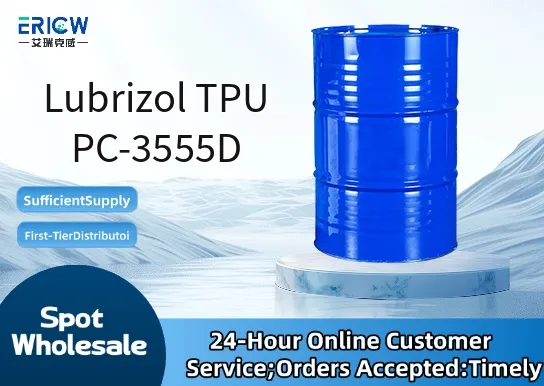
| Chemical Type | Thermoplastic Polyurethane (TPU), Polyester-based |
| Product Form | Pellets |
| Appearance | Off-white to light tan, free-flowing pellets |
| Primary Applications | Overmolding, flexible components, PC/TPU alloys |
| Key Features | Low-temperature flexibility, oil resistance, PC compatibility |
| Benefits | Improved part toughness, reduced cycle times, enhanced surface aesthetics |
| Processing Method | Injection molding, extrusion, two-shot molding |
| Recommended Drying | 80–90 °C for 2–4 hours prior to processing |
Q1: What is the primary function of Lubrizol TPU PC-3555D in thermoplastic polyurethane (TPU) formulations?
A: Lubrizol TPU PC-3555D is a high-performance processing aid designed to improve melt flow, reduce extrusion pressure, and enhance surface finish in TPU compounds—particularly during extrusion and injection molding operations.
Q2: Is Lubrizol TPU PC-3555D compatible with aromatic and aliphatic TPU grades?
A: Yes, PC-3555D demonstrates broad compatibility across both aromatic and aliphatic TPU chemistries, supporting consistent performance in diverse formulation systems without compromising mechanical properties or clarity.
Q3: How should Lubrizol TPU PC-3555D be incorporated into a TPU compound?
A: It is typically added directly to the TPU resin prior to melt processing—via dry blending or side feeding—and disperses readily under standard extrusion conditions. Pre-drying of the additive is not required.
Q4: Does PC-3555D affect the thermal stability or long-term aging behavior of TPU?
A: When used at recommended dosage levels, PC-3555D does not negatively impact thermal stability or accelerate oxidative degradation; it remains inert under typical TPU processing and end-use temperature ranges.
Contact With Us:
E-mail: wangxingqiang@ericwchem.com
Have a Questions? Call Us:
Add:
Building A1, Jiete Industrial Park, Huangpu District, Guangzhou City, Guangdong Province, China