English
 Español
 tiếng việt
 русский
Highly reactive liquid epoxy resin with low viscosity for excellent processability and wetting.
Superior thermal stability and chemical resistance after curing with appropriate hardeners.
Consistent molecular weight distribution ensuring reproducible performance in formulation.
Low chloride content supporting high electrical insulation properties in electronic applications.
Compatible with a broad range of amine, anhydride, and phenolic curing agents.
Electrical encapsulation and potting compounds for transformers and sensors.
High-performance laminating resins for printed circuit board (PCB) prepregs.
Structural adhesives requiring elevated temperature resistance and toughness.
Composite matrix resins for aerospace and wind energy components.
Coatings and linings for corrosion-resistant industrial equipment.
| Chemical Type | Diglycidyl ether of bisphenol-A (DGEBA) |
| Product Form | Clear to pale yellow liquid |
| Appearance | Transparent, slightly viscous liquid at room temperature |
| Epoxy Equivalent Weight (EEW) | 185–192 g/eq |
| Viscosity at 25°C | 12–16 Pa·s (12,000–16,000 cP) |
| Chloride Content | ≤ 750 ppm |
| Softening Point | Not applicable (liquid at 25°C) |
| Key Features | Low viscosity, high reactivity, low ionic impurities, excellent dielectric strength |
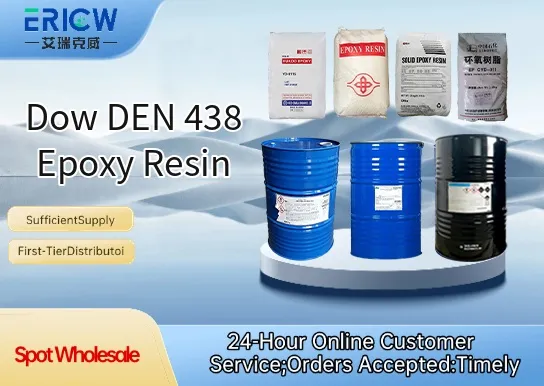
Q1: What is the primary chemical nature and typical use of Dow DEN 438 Epoxy Resin?
A: Dow DEN 438 is a solid, novolac-type epoxy resin based on phenol-formaldehyde condensates, offering high functionality and excellent thermal and chemical resistance. It is commonly used as a reactive modifier or co-resin in high-performance composite, adhesive, and encapsulation formulations where enhanced crosslink density and durability are required.
Q2: How does DEN 438 differ from standard DGEBA epoxy resins like DER 331 or EPON 828?
A: Unlike conventional diglycidyl ether of bisphenol-A (DGEBA) resins, DEN 438 features a multi-epoxy, rigid aromatic backbone with higher epoxide equivalent weight (EEW) and significantly greater functionality—typically averaging more than 4 epoxy groups per molecule. This results in higher glass transition temperatures, improved resistance to solvents and elevated temperatures, and reduced flexibility in cured networks.
Q3: What types of curing agents are compatible with DEN 438?
A: DEN 438 is typically cured with high-temperature amine hardeners (e.g., dicyandiamide, aromatic diamines), anhydrides, or phenolic resins. Due to its high melting point and low reactivity at ambient conditions, it generally requires elevated cure temperatures—often above 120 °C—and may benefit from accelerator systems to achieve practical processing windows.
Q4: Is DEN 438 suitable for electrical insulation applications?
A: Yes—its high purity, low ionic content, and ability to form densely crosslinked, moisture-resistant networks make DEN 438 well-suited for electrical encapsulants, potting compounds, and insulating varnishes, particularly in demanding environments such as power electronics and aerospace components.
Q5: How should DEN 438 be handled and stored to maintain stability?
A: DEN 438 should be stored in a cool, dry place below 30 °C in original sealed packaging to prevent moisture absorption and premature solidification. As a solid resin, it requires pre-heating (typically to 80–100 °C) for handling and metering; prolonged exposure to humidity or elevated temperatures during storage may affect flow behavior and processing consistency.
Contact With Us:
E-mail: wangxingqiang@ericwchem.com
Have a Questions? Call Us:
Add:
Building A1, Jiete Industrial Park, Huangpu District, Guangzhou City, Guangdong Province, China