English
 Español
 tiếng việt
 русский
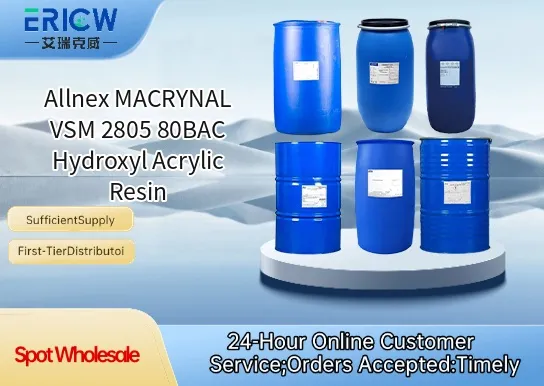
High hydroxyl functionality for excellent crosslink density with melamine and polyisocyanate curing agents.
Optimized molecular weight distribution for balanced flow, leveling, and film hardness development.
Low VOC formulation compatible with high-solids coating systems meeting stringent environmental regulations.
Superior weatherability and UV resistance due to acrylic backbone stability and low aromatic content.
Good compatibility with common solvent-borne resins and additives used in industrial coatings.
Automotive OEM topcoats and clearcoats.
Industrial maintenance coatings for metal substrates.
General-purpose coil coatings requiring durability and gloss retention.
High-performance appliance finishes.
Refinish coatings for automotive and heavy equipment applications.
| Chemical Type | Hydroxyl-functional acrylic copolymer |
| Product Form | Liquid resin solution |
| Appearance | Clear, pale yellow liquid |
| Solvent System | Xylene / butyl acetate blend |
| Non-Volatile Content (wt%) | 80 ± 1 % |
| Hydroxyl Value (mg KOH/g) | 65 – 75 |
| Acid Value (mg KOH/g) | < 5 |
| Viscosity (25°C, mPa·s) | 4,000 – 6,000 |
Q1: What is the primary function of MACRYNAL VSM 2805 80BAC in coating formulations?
A: It serves as a hydroxyl-functional acrylic resin designed to act as a reactive binder in two-component polyurethane and melamine-cured systems, contributing to film formation, hardness development, and chemical resistance.
Q2: Is this resin suitable for high-solids or low-VOC applications?
A: Yes — its formulation supports reduced solvent demand and is commonly incorporated into medium- to high-solids industrial coatings where VOC compliance and efficient application are key considerations.
Q3: How does VSM 2805 80BAC perform in terms of weathering and UV stability?
A: As a purely acrylic hydroxyl resin, it offers excellent inherent UV resistance and long-term gloss retention, making it well-suited for exterior architectural and industrial maintenance coatings requiring durable aesthetics.
Q4: Can it be blended with other resins such as alkyds or polyester polyols?
A: Yes — it exhibits good compatibility with many common polyols and crosslinkers, including melamine formaldehydes and isocyanates, and can be co-formulated with select alkyd or polyester resins to balance flexibility, cure speed, and performance attributes.
Contact With Us:
E-mail: wangxingqiang@ericwchem.com
Have a Questions? Call Us:
Add:
Building A1, Jiete Industrial Park, Huangpu District, Guangzhou City, Guangdong Province, China