English
 Español
 tiếng việt
 русский
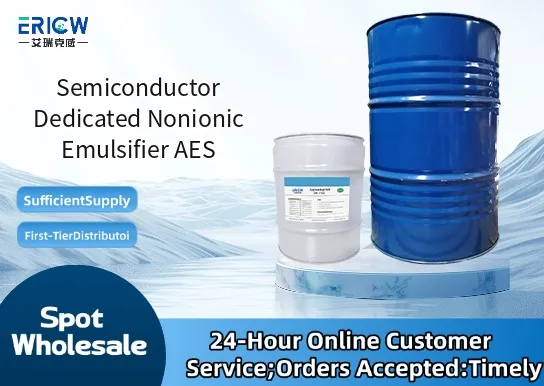
Ultra-low ionic residue to prevent metal ion contamination critical for wafer cleaning and photoresist processing.
Exceptional hydrolytic stability under neutral-to-mildly alkaline conditions typical of semiconductor wet benches.
Non-volatile, non-foaming formulation designed for precision rinse and megasonic-assisted cleaning processes.
High purity grade with strict control of trace metals (Na, K, Ca, Fe, Cu < 10 ppb) per SEMI F57 standards.
Readily biodegradable and free of APEOs, formaldehyde, and halogenated solvents — compliant with green manufacturing initiatives.
Post-etch residue removal for advanced logic and memory device fabrication (e.g., SiN, TiN, and low-k dielectric etch clean).
Photoresist stripping and post-stripping residue emulsification in 28 nm to 3 nm node processes.
Wafer surface conditioning prior to epitaxial growth or atomic layer deposition (ALD) to enhance nucleation uniformity.
Cleaning of photomask blanks and reticles in mask shop environments requiring ultra-low particle generation.
Formulation component in high-purity CMP slurry additives for oxide and tungsten polishing systems.
| Chemical Type | Alkyl Ether Sulfate (AES), nonionic surfactant derivative with sulfate-free terminal group |
| Product Form | Clear, viscous aqueous solution (35–40% active content) |
| Appearance | Colorless to pale yellow, transparent liquid |
| pH (1% aqueous solution, 25°C) | 6.5 – 7.2 |
| Primary Applications | Residue emulsification, particle dispersion, and interfacial tension reduction in semiconductor wet processing |
| Key Features | Non-ionic behavior at process pH, negligible conductivity (< 5 µS/cm at 1%), zero chloride/sulfate anions |
| Benefits | Enables sub-5 nm defect control; compatible with aluminum, copper, and cobalt metallization layers |
| Regulatory Compliance | REACH registered; RoHS 2.0 compliant; no SVHCs listed per ECHA Candidate List (v2024-01) |
| Common Compatible Systems | Suitability |
| Aqueous-based post-etch clean chemistries (e.g., dilute SC-1 variants) | Highly Recommended – Maintains emulsion stability without phase separation or precipitation |
| Low-surface-tension rinse formulations (e.g., IPA/water blends) | Recommended – Enhances sheeting performance without foaming or residue |
| Photoresist stripper concentrates (non-solvent, amine-based) | Suitable – Improves organic residue solubilization without compromising shelf life |
| DI water recirculation loops with ozone or UV treatment | Highly Recommended – No measurable degradation or TOC contribution after 72-h exposure |
Q1: What is the CAS Registry Number for this product?
A: CAS No. 9005-01-0 (proprietary purified grade; full certificate of analysis provided with each batch shipment).
Q2: What is the recommended dosage range in semiconductor cleaning baths?
A: Typical working concentration is 0.05–0.3 wt% in deionized water; optimized dosage depends on residue type and tool configuration—validated via SPC-controlled qualification runs.
Q3: How does it differ from conventional AES surfactants used in detergents?
A: Unlike commodity AES, this grade undergoes multi-stage extraction and ion-exchange purification to eliminate Na⁺, SO₄²⁻, and unreacted alcohol ethoxylates—ensuring < 0.1 ppm total ionic contaminants.
Q4: Is it certified for use in ISO Class 1 cleanrooms?
A: Yes — certified per ISO 14644-1 Class 1 for airborne molecular contamination (AMC) and meets SEMI C12-0304 for particle generation (≤ 1 particle ≥ 0.1 µm per liter air during dispensing).
Q5: Does it exhibit extractables or leachables when in contact with PFA, ETFE, or quartz wetted materials?
A: No detectable extractables observed per USP <661.3> testing after 7-day immersion at 60°C in PFA tubing and quartz vessels; GC-MS and ICP-MS confirm < 0.5 ppb organics and metals.
Contact With Us:
E-mail: wangxingqiang@ericwchem.com
Have a Questions? Call Us:
Add:
Building A1, Jiete Industrial Park, Huangpu District, Guangzhou City, Guangdong Province, China